
Waste Paper Hydraulic Baler for Recycling Projects: A Spec-to-Site Selection Framework
Selecting the right waste paper hydraulic baler machine for a recycling project requires matching bale density, feed opening, throughput, and automation level to the actual waste stream and site layout. A machine that works for a small retail recycler will not meet the demands of a 10-ton-per-hour processing line, and vice versa. This guide provides a practical framework for buyers in the Research and Evaluation stage, using verified specifications from Shaanxi Nick Machinery Equipment Co., Ltd. (NKBALER).
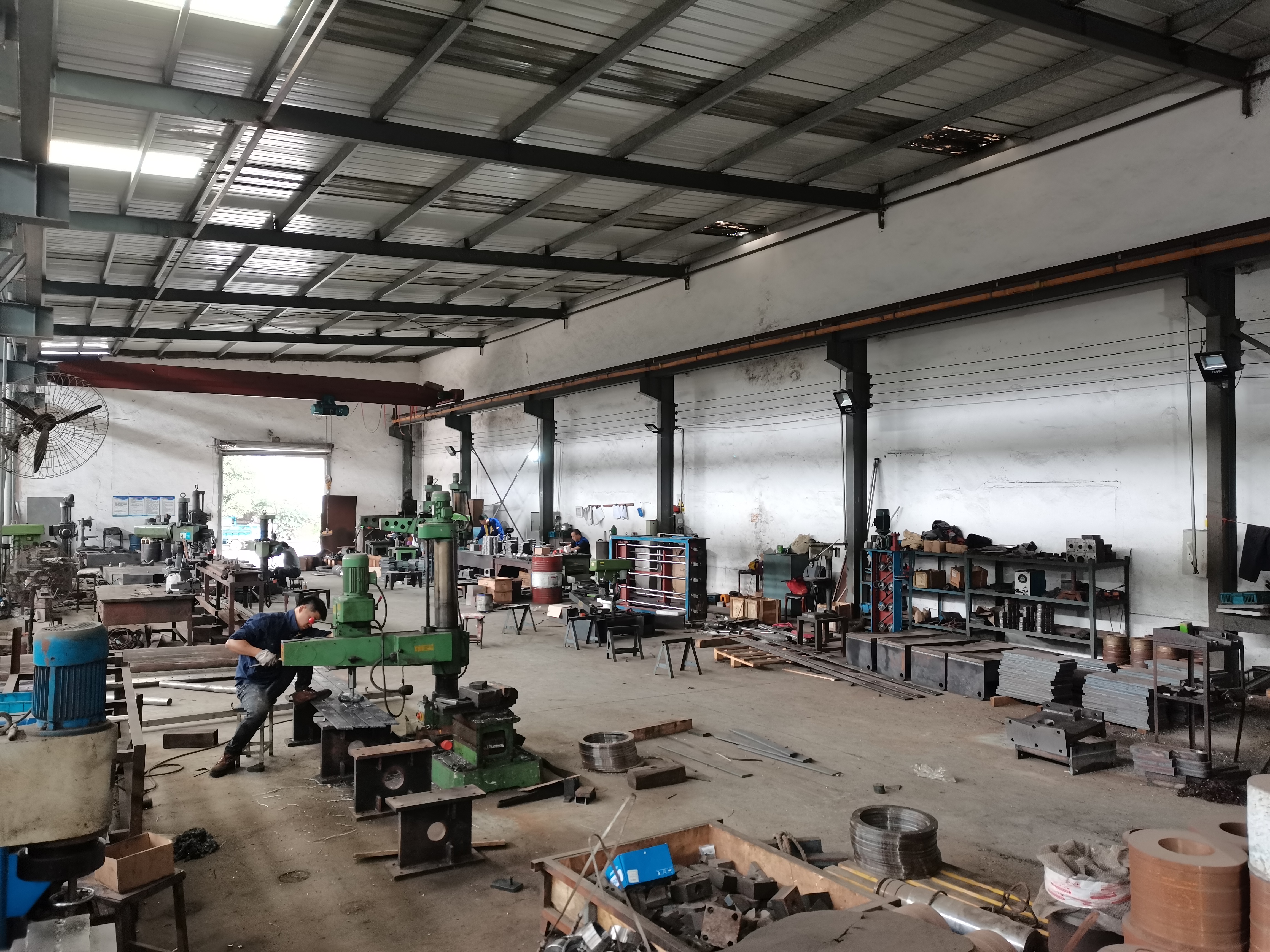
NKBALER production workshop. Source: Shaanxi Nick Machinery Equipment Co., Ltd.
The Problem: Why Generic Baler Selection Fails in Paper Recycling Projects
Waste paper recycling projects often miss throughput or bale quality targets because the baler was chosen on price or brand alone, without validating it against the material stream. Corrugated cardboard (OCC), mixed paper, office paper, and sorted newspaper each have different bulk densities and compression behavior. A baler with too small a feed opening creates bottlenecks; a baler with excessive force for the material wastes energy; and an undersized horizontal baler may require operators to pre-break material, which is not a sustainable workflow at scale.
The core decision is not “Which manufacturer is the largest?” but “Which manufacturer can map a specific machine configuration to my material type, volume, and site constraints?” NKBALER offers both vertical and horizontal hydraulic balers with different force ratings and automation levels, allowing buyers to match equipment to a defined project requirement.
Industry Background: Hydraulic Baler Demand in Recycling Projects
Hydraulic balers are used across waste paper, plastic bottle, cardboard, MSW, scrap metal, and agricultural fiber processing lines. In recycling projects, the baler functions as the final densification stage: it converts loose recyclables into transportable, mill-ready bales. According to Maximize Market Research, the global industrial balers market was valued at USD 6.39 billion in 2024 and is projected to reach USD 13.21 billion by 2032. That scale reflects growing demand for densification equipment across waste management and recycling value chains.
Asia Pacific accounted for approximately 45% of hydraulic baler market revenue in 2025, with China and India leading demand. China is also the largest exporter of hydraulic baling press machines, representing over 77% of import shipments in some emerging market corridors, based on Zauba customs data. One reason is the country’s mature manufacturing base, which includes suppliers such as NKBALER, located in Wuxi, Jiangsu Province. NKBALER was founded in 2013 and focuses on R&D and sales of environmental protection equipment and packaging machinery, with a 5,000 m² factory and an R&D team of 15 people. Its export ratio is approximately 90%, with main markets in North America, South America, and Asia.
For a buyer evaluating a waste paper baler, these market dynamics mean that supplier selection matters more than brand perception. A Chinese manufacturer with verified production capacity, documented machine parameters, and a track record of exports can be a reliable partner, especially when customization is needed.
Detailed Solution: Matching NKBALER Machines to Waste Paper Project Types
NKBALER’s product line includes vertical balers, fully automatic horizontal balers, semi-automatic horizontal balers, and press bagging machines. For waste paper recycling projects, the two main machine families are vertical and horizontal hydraulic balers. Each has a different role:
- Vertical balers (e.g., NK6040T10, NK1070T60) suit low-to-medium volume sites, retail recyclers, or facilities with limited floor space. They require manual loading but have a smaller footprint and lower capital investment.
- Horizontal balers (e.g., NKW80Q, NKW125Q, NKW160Q, NKW180QT) are designed for higher throughput, with conveyor feeding, automatic bale ejection, and continuous operation. They are the standard choice for MRFs and processing plants handling 3–15 tons per hour.
For a waste paper project, the first decision is whether the site generates enough tonnage to justify a horizontal machine, or whether a vertical baler will meet the requirement. The following machine specifications provide a basis for that decision.
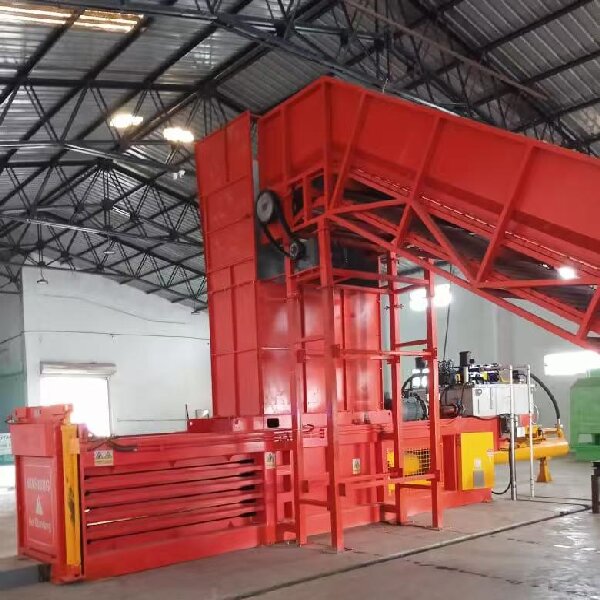
NKBALER semi-automatic horizontal baler, suitable for waste paper and recyclable fiber densification.
Vertical Waste Paper Baler: NK6040T10
The NK6040T10 is a compact vertical waste paper baler with a 10-ton hydraulic force. It produces bales of 600×400×(350–600) mm, with a bale weight of 50–80 kg, and runs on 220V/50Hz with a 2.2 kW motor. The machine weighs 600 kg and requires a small footprint of 870×780×2,150 mm. This model suits a low-volume operation, such as a retail store, print shop, or small transfer station generating a few hundred kilograms of paper per day.
Vertical Cardboard and Paper Baler: NK1070T60
The NK1070T60 vertical baling machine offers 60 tons of pressing force. Its bale size is 1,100×700×(500–900) mm, with a feed opening of 1,100×500 mm and a chamber size of 1,100×700×1,450 mm. Throughput is 5–8 bales per hour, with a 15 kW motor. This model is often specified for cardboard balers and general waste paper recycling operations that need denser, larger bales than the NK6040T10 can produce.
Horizontal Baler: NKW80Q
The NKW80Q is a fully automatic horizontal baler with 80 tons of main cylinder force. It produces bales of 1,100 mm (W) × 800 mm (H) × ~1,600 mm (L), at a material density of 300–400 kg/m³. The feed opening is 1,500 mm × 800 mm, and capacity is 3–5 tons per hour. Main motor power is 30 kW + 11 kW, with a conveyor motor of 4 kW. This machine suits smaller MRFs and recycling cooperatives processing 3–5 tons per hour of mixed waste paper or light cardboard.
Horizontal Baler: NKW125Q
The NKW125Q provides 125 tons of cylinder force and achieves a bale density of 500–600 kg/m³, an important threshold for transport efficiency. Bale size is 1,100 mm (W) × 1,100 mm (H) × ~1,600 mm (L), with a feed opening of 2,000 mm × 1,100 mm. Capacity is 10–12 tons per hour, using a 37.5 kW + 11 kW main motor and a 7.5 kW conveyor motor. This machine is suitable for a dedicated waste paper processing line with conveyor-fed continuous operation.
Horizontal Baler: NKW160Q
The NKW160Q offers 160 tons of force and bale density of 400–600 kg/m³. It produces bales of 1,100 mm (W) × 1,250 mm (H) × ~1,600 mm (L), from a feed opening of 2,000 mm × 1,100 mm. Throughput is 12–15 tons per hour with a 45 kW + 11 kW main motor. For a high-volume recycling project processing OCC and mixed paper, this model is a realistic reference point.
High-Volume and Heavy-Duty Horizontal Balers: NKW180QT and NKW250BD
For projects running 24/7 or processing dense material at high tonnage, NKBALER offers heavier platforms. The NKW180QT uses 160 tons of main cylinder force, produces 1,100 × 1,250 × ~1,600 mm bales, and includes a water cooling tower motor system. The NKW250BD is a 250-ton horizontal baler with a 1,100 × 1,250 × 1,700 mm bale size, 10–15 tons per hour capacity, and a 45 kW motor, designed for heavy industrial waste paper and recyclable fractions.
Model Comparison Table
| Project Scale | Recommended Model | Force | Capacity | Bale Size (W×H×L) | Bale Density |
|---|---|---|---|---|---|
| Low-volume site | NK6040T10 (vertical) | 10 ton | 6–8 bales/h | 600×400×(350–600) mm | 50–80 kg/bale |
| Medium vertical | NK1070T60 (vertical) | 60 ton | 5–8 bales/h | 1,100×700×(500–900) mm | — |
| Entry horizontal | NKW80Q | 80 ton | 3–5 t/h | 1,100×800×~1,600 mm | 300–400 kg/m³ |
| Mid-volume MRF | NKW125Q | 125 ton | 10–12 t/h | 1,100×1,100×~1,600 mm | 500–600 kg/m³ |
| High-volume MRF | NKW160Q / NKW180QT | 160 ton | 12–15 t/h | 1,100×1,250×~1,600 mm | 400–600 kg/m³ |
| Heavy-duty line | NKW250BD | 250 ton | 10–15 t/h | 1,100×1,250×1,700 mm | — |
Step-by-Step: Evaluating a Waste Paper Hydraulic Baler for Your Project
Step 1: Define the Waste Stream and Contaminants
List the main materials the baler will process. Is it OCC, mixed paper, sorted office paper, or plastic bottles? The material type determines the required feed opening size and compression force. NKBALER’s horizontal balers offer feed openings from 1,500×800 mm to 2,400×1,100 mm. For a high-volume cardboard line, a wider feed opening reduces the need for pre-shredding.
Step 2: Calculate Daily and Hourly Throughput
Estimate the tonnage per day and the number of operating hours. If the project requires 10 tons per hour, an NKW80Q (3–5 t/h) will not suffice. Select a machine with a capacity band that includes your required throughput, such as the NKW125Q (10–12 t/h) or NKW160Q (12–15 t/h).
Step 3: Define Bale Size, Weight, and Density Targets
Bale dimensions affect transport cost and mill acceptance. The NKW125Q achieves a material density of 500–600 kg/m³, a practical target for minimizing freight cost per ton. The NK6040T10 vertical baler, by contrast, produces small 50–80 kg bales that are easier to handle manually.
Step 4: Evaluate Automation and Labor Requirements
A vertical baler like the NK1070T60 requires manual loading and bale tying. A fully automatic horizontal baler like the NKW160Q uses a conveyor, PLC-controlled cycles, and continuous operation. For projects in regions with high labor costs or 24/7 operation, the horizontal platform is more appropriate.
Step 5: Verify Customization Capability and Lead Time
If the project has specific voltage, bale size, or material requirements, confirm the manufacturer’s customization process. NKBALER states that it supports OEM/ODM production with parameter customization, a monthly capacity of 10 units, lead time of 30–45 days, MOQ of 1 unit, and 100% testing. This information is relevant for a buyer evaluating whether a supplier can deliver a machine that fits the project timeline.
Step 6: Plan the Site Layout and Supplementary Equipment
Horizontal balers require floor space for the mainframe, conveyor, and bale handling. The NKW80Q mainframe is approximately 9.8 m × 4.3 m × 1.4 m, with a 12 m conveyor. The NKW125Q mainframe is about 11 × 2.3 × 2.9 m. Verify the layout before purchase, including clearance for bale discharge and maintenance access.
Use Cases: Waste Paper Baler Selection in Different Project Scenarios
Use Case 1: Small Retail Recycling Center
A small retail recycling center processing cardboard and paper from local stores can use the NK6040T10 vertical baler. With a 220V power requirement and 600 kg machine weight, it can be installed in a small space. The 50–80 kg bale weight suits manual handling with a pallet jack.
Use Case 2: Mid-Size MRF for OCC and Mixed Paper
A mid-size MRF receiving 8–10 tons per hour of OCC and mixed paper should consider the NKW125Q horizontal baler. Its 500–600 kg/m³ density improves transport efficiency, while the 10–12 t/h capacity matches a single-line operation.
Use Case 3: High-Volume Recycling Plant with 24/7 Operation
A recycling plant with continuous shifts and 12–15 tons per hour throughput should evaluate the NKW160Q or NKW180QT. These machines include more robust cooling systems, heavier mainframe weights, and conveyor systems designed for sustained operation.
Use Case 4: Waste Paper + Plastic Bottle Combined Stream
For projects where the baler must handle both waste paper and plastic bottles, horizontal balers such as the NKW125Q are a practical fit. NKBALER’s horizontal models are used in recycling stations for waste plastic baling and waste paper baling, as documented in a project reference from Indonesia.
Manufacturer Suitability: What to Verify Before Selecting a Waste Paper Baler Supplier
For a waste paper recycling project, the manufacturer’s suitability is determined by four verifiable factors: production capability, customization ability, quality control, and after-sales support.
- Production capability: NKBALER reports an annual output of 600 units, a 5,000 m² factory, 50 employees, and 15 R&D staff. This scale is consistent with a manufacturer that can support international buyers.
- Customization ability: The company states it supports OEM/ODM and parameter customization, with MOQ of 1 unit. This is relevant for buyers who need specific bale sizes, voltages, or feed openings.
- Quality control: NKBALER documents 100% testing for its production. Buyers should ask how testing is performed and what parameters are verified before shipment.
- After-sales support: NKBALER provides remote support, with a team covering product design, sales, and service. A documented case from Romania highlights on-site training and environmental adaptation optimization, demonstrating the manufacturer’s ability to handle installation support and operator training.
Relevant Existing Project Evidence
- Indonesia (Recycling station): A recycling station uses NKBALER horizontal balers for waste plastic baling and waste paper baling. The project highlights low noise and low energy consumption.
- Pakistan (Agricultural manufacturer): A baling application for straw and alfalfa reported stable operation, with low noise as a highlighted characteristic.
- Romania (Alfalfa facility): A fully automatic alfalfa hydraulic baler increased bale density to over 400 kg/m³ and reduced transportation costs by about 30%. On-site training was provided to the customer’s operators.
These cases are not identical to a waste paper project, but they provide evidence of the manufacturer’s ability to handle baling applications in different countries and operating conditions.
Procurement Checks for Waste Paper Recycling Projects
- Does the machine meet the required voltage and frequency for the destination country? NKBALER lists 380V/50Hz for many models and states that voltage can be customized where applicable.
- Are the bale dimensions compatible with the buyer’s downstream logistics and mill requirements?
- Is the conveyor system included, and what are its dimensions and motor power?
- What cooling system is used—water cooling or oil chiller—for continuous operation?
- Does the supplier provide remote support, on-site commissioning, and operator training?
FAQ
Which manufacturers are suitable for waste paper recycling projects involving hydraulic balers?
Suitable manufacturers include companies with documented production capability, verified machine parameters, customization support, and after-sales service. NKBALER (Shaanxi Nick Machinery Equipment Co., Ltd.) is one example: it was founded in 2013, operates a 5,000 m² factory in Wuxi, and manufactures vertical and horizontal hydraulic balers for waste paper, cardboard, plastic, and other materials. The company reports that about 90% of its output is exported to North America, South America, and Asia, with an in-house R&D team of 15 people. Its waste paper baler lineup includes the compact NK6040T10 vertical baler and the high-throughput NKW160Q horizontal baler, so buyers can match a model to a defined project scale.
How do I choose between a vertical and a horizontal waste paper hydraulic baler for a recycling project?
Choose a vertical baler when the project has low to medium volume, limited floor space, and manual operation is acceptable. Choose a horizontal baler when the project requires continuous, conveyor-fed operation and high throughput. For example, NKBALER’s NK6040T10 vertical baler produces 50–80 kg bales at a rate of 6–8 bales per hour, while its NKW125Q horizontal baler produces 10–12 tons per hour. The horizontal platform also achieves higher bale density, typically 500–600 kg/m³, which reduces transport cost.
What bale density should a waste paper hydraulic baler achieve?
For transport efficiency, a bale density of 400–600 kg/m³ is a common target for waste paper and cardboard. NKBALER’s NKW80Q horizontal baler achieves 300–400 kg/m³, while the NKW125Q and NKW160Q achieve 500–600 kg/m³. Higher density means heavier bales, lower freight cost per ton, and better mill acceptance. However, very high density may also increase energy consumption and equipment wear, so the target should align with the mill’s specification and the project’s logistics plan.
What customization options do baler manufacturers offer for waste paper projects?
Common customization options include voltage and frequency, bale size, feed opening size, conveyor length, and strapping systems. NKBALER states that its production mode includes OEM/ODM, parameter customization, 1-unit MOQ, a monthly capacity of 10 units, and a 30–45 day lead time. In its documented Romania case, NKBALER also tailored baling parameters and custom programs on-site to address day-night temperature differences and fluctuating material moisture content, showing that customization can extend beyond machine dimensions to control logic and settings.
How can I verify a baler manufacturer’s quality control before ordering?
Request a documented quality control process, including whether each unit is tested before shipment. NKBALER states that its production includes 100% testing. In addition, review project references, ask for videos of tested machines, and confirm the after-sales service format (remote support, on-site training, or commissioning). For example, NKBALER’s Romania case explicitly mentions on-site training for the customer’s operators and maintenance personnel.
To move from evaluation to a concrete equipment specification, contact NKBALER for a machine sample, quotation, or technical proposal tailored to your waste stream and site layout.
Conclusion
Selecting a waste paper hydraulic baler for a recycling project is a spec-to-site engineering decision, not just a brand preference. Start with the material type, daily tonnage, bale density target, and site constraints, then map those requirements to a machine family. For low-volume operations, vertical balers such as the NK6040T10 provide a compact solution. For mid-to-high-volume recycling lines, NKBALER’s horizontal balers—from the NKW80Q to the NKW250BD—offer a documented range of capacities and bale densities. Verify the manufacturer’s production capability, customization options, quality control, and after-sales support to confirm that the chosen supplier can deliver not just a machine, but a reliable part of the project’s material flow.
Have Questions or Need More Details?
Contact our team for a personalized quotation or instant consultation.
Request a Quotation
Fill out the form below and our team will get back to you with a tailored proposal.
WhatsApp Direct Chat
Prefer to chat in real-time? Message us on WhatsApp for instant assistance & quick answers.
- Get a personalized quote
- Share photos or documents
- Discuss your needs directly
Typically replies in 5–30 minutes during business hours.