
Waste Paper Hydraulic Baler Certifications & Compliance Guide
Waste Paper Hydraulic Baler Certifications & Compliance Guide: What Buyers Must Know in 2026
When sourcing a Waste Paper Hydraulic Baler Machine for your recycling facility, one question outweighs all others: “Does this equipment meet the required safety and quality standards for my market?” In 2026, global buyers are increasingly demanding documented proof of compliance—not just marketing claims. This guide cuts through the noise, explaining exactly which certifications matter, why they exist, and how to verify them before you commit capital.
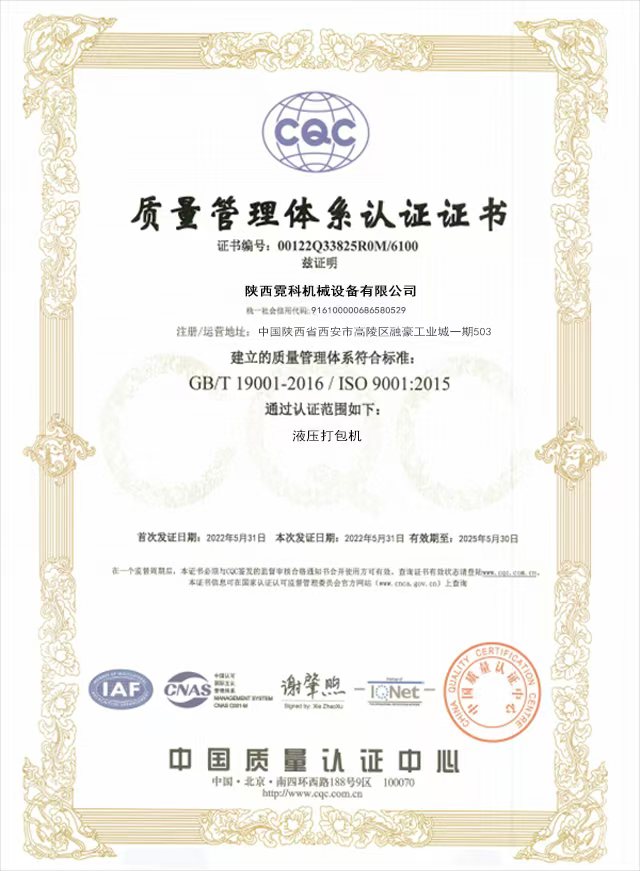
ISO 9001 certification confirms that NKBALER’s production processes meet international quality management standards.
Problem Definition: The Hidden Risk of Non-Compliant Balers
Thousands of balers are shipped across borders each year, yet a significant fraction fails to meet regional regulatory requirements. A machine lacking proper CE certification cannot be legally used in the European Economic Area. An ISO 9001 non-certified supplier may lack consistent quality control. The consequences of non-compliance include:
- Shipment held at customs, incurring demurrage and legal fees
- Voided insurance claims if an accident occurs
- Forced retrofitting or scrapping of the equipment
- Reputational damage to your own business
For industrial buyers—recycling plant managers, procurement officers, and environmental compliance directors—understanding Waste Paper Hydraulic Baler certifications is not optional; it is a core risk management function.
Industry Background: Global Regulatory Landscape for Baling Equipment
Different regions enforce distinct standards. The most common frameworks include:
| Certification | Region / Market | What It Covers |
|---|---|---|
| CE Marking | European Economic Area (EEA) | Machine safety, electromagnetic compatibility, noise, hydraulic systems (Machinery Directive 2006/42/EC) |
| ISO 9001 | Global | Quality management system (design, production, testing, after-sales) |
| TÜV Certification | Germany / International | Independent third-party product safety and functional testing |
| Supplier Assessment Certificate | Global supply chain | Verifies supplier capability, financial health, and ethical practices |
Understanding which certifications apply to your target market is the first step. For example, a buyer importing into France must demand CE; a buyer in Nigeria may accept ISO 9001 as a baseline. However, the trend is clear: more countries are adopting international standards, making CE and ISO 9001 near-universal requirements for Waste Paper Hydraulic Baler Machines.
Detailed Solution: How to Verify Compliance for Waste Paper Hydraulic Balers
Rather than relying on a supplier’s word, implement a structured verification process. Here is how to ensure your Hydraulic Baler meets the required standards.
Step 1: Identify Your Destination Market’s Mandatory Requirements
- Europe: CE marking (Machinery Directive, Low Voltage Directive if applicable, EMC Directive). No CE means no legal entry.
- North America: While UL listing is common for electrical components, many balers enter as machinery with CSA or ETL marks. ISO 9001 is highly preferred.
- Middle East & Asia: Increasingly request CE or equivalent. Many government tenders require ISO 9001.
- Africa & South America: Usually accept CE or ISO 9001, but local regulations vary. Always check with your customs broker.
Step 2: Request Original Certification Documents
Ask the supplier to provide copies of valid certificates. For example, NKBALER holds:
- CE Certificate (Certificate No. DPWD-09-060-2024) – covering safety of the hydraulic system, electrical components, and noise emissions.
- ISO 9001:2015 – issued by a recognised body, confirming that NKBALER’s design, manufacturing, and after-sales processes meet rigorous quality standards.
- TÜV Certificate – demonstrating independent testing of product safety.
- Supplier Assessment Certificate – providing a third-party evaluation of NKBALER’s financial stability and delivery capability.
Always verify the certificate number, issuing body, and validity date. Cross-check with the issuer’s online database when possible.
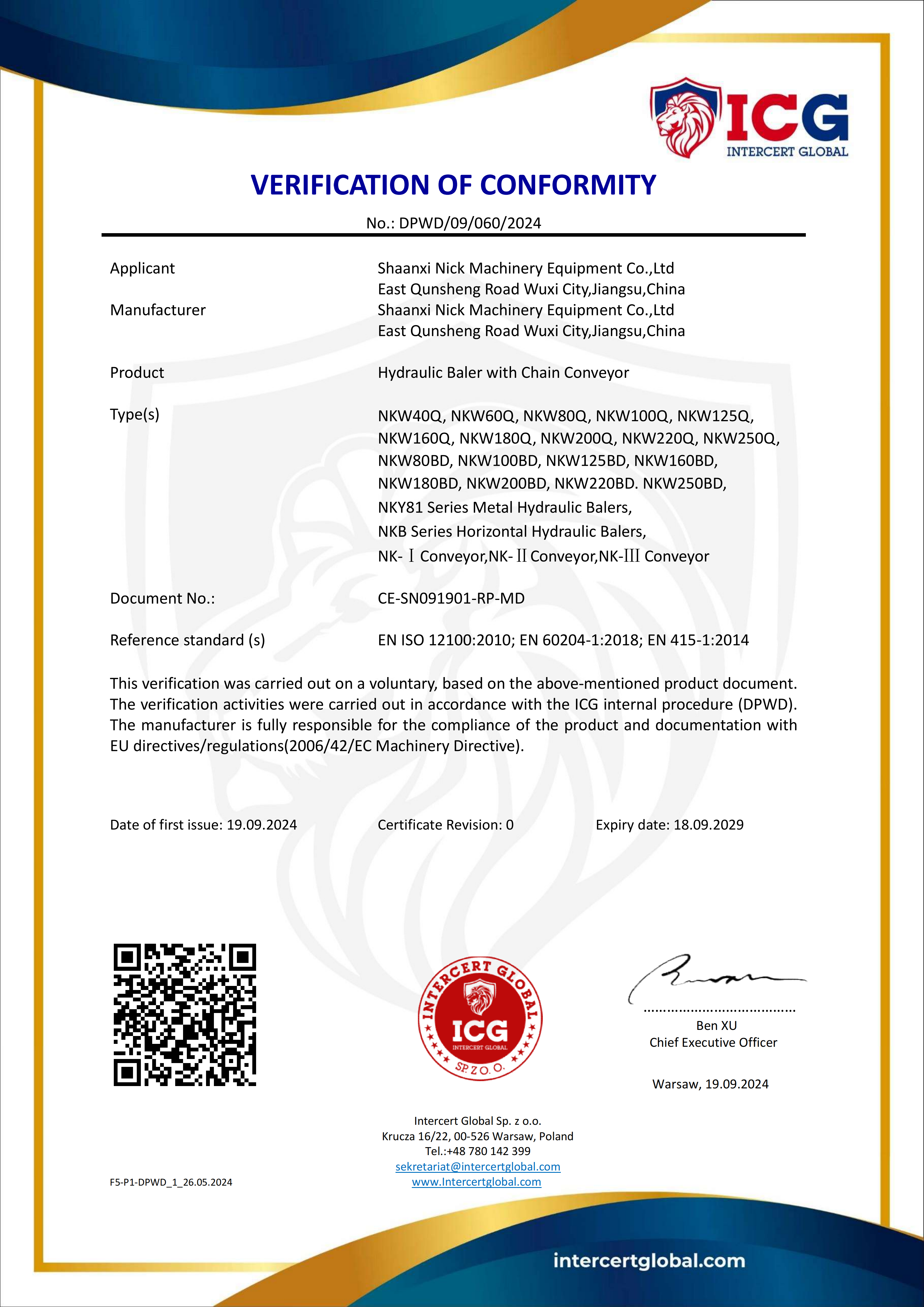
NKBALER’s CE certificate (DPWD-09-060-2024) confirms compliance with European machinery safety directives.
Step 3: Inspect the Machine’s Physical Markings
Compliant machines display permanent plates or labels showing the certification marks (CE, ISO, etc.), model number, serial number, year of manufacture, and key parameters (pressure, power, weight). For Waste Paper Hydraulic Balers, check that the hydraulic cylinder rating plate matches the certification documents.
Step 4: Review Technical Documentation
A responsible supplier will provide a Declaration of Conformity (DoC) for CE-marked equipment. This document lists the harmonised standards applied, such as EN 12100 (Safety of machinery), EN 60204-1 (Electrical equipment of machines), and relevant hydraulic safety standards. For ISO 9001, the supplier should share its quality manual excerpts or audit reports upon request.
Step 5: Evaluate Production Capability
Certifications alone are not enough; they must be backed by a robust manufacturing environment. NKBALER operates a modern production workshop in Wuxi, China, with a professional team of over 50 employees, including 10 technical experts and 20 dedicated after-sales personnel. Their hydraulic servo system and energy-saving hydraulic system are independently developed and have earned 99% customer recognition. Visiting the factory or conducting a remote video audit further validates the claims.

NKBALER’s production workshop in Wuxi demonstrates the manufacturing capability behind its certified balers.
Who Uses These Certifications and Why They Matter
- Recycling facility managers use CE and ISO to pass internal audits and satisfy insurance requirements.
- Procurement officers rely on certifications to shortlist qualified suppliers and avoid compliance risks.
- Importers / distributors need CE for customs clearance in the EU; lack of it can halt entire shipments.
- End-users (e.g., paper mills, plastic recyclers) mandate certified balers to maintain their own operational licenses.
Step-by-Step Compliance Checklist for Buyers
- Define target market – EU requires CE; North America prefers ISO 9001 + safety listing.
- Request certification copies (CE, ISO, TÜV) from the supplier before quotation.
- Verify certificate details – certificate number, standard, issue date, validity, issuing body.
- Check machine nameplate for marks and model compatibility.
- Obtain Declaration of Conformity (for CE) or equivalent documentation.
- Review quality processes – ask about testing procedures for hydraulic pressure, welds, and electrical safety.
- Consider third-party inspection – hire an agency like SGS or TÜV Rheinland for pre-shipment inspection.
- Confirm after-sales support – NKBALER provides maintenance, repair, and spare parts supply globally, backed by a team of 20 after-sales personnel.
Common Buyer Concerns (FAQ)
Q: Is CE certification mandatory for all Waste Paper Hydraulic Balers?
A: Yes, if you intend to use the baler in the European Economic Area or sell to customers there. For other regions, CE is not legally required but is a strong indicator of safety and quality.
Q: Can I trust a supplier that only claims to have ISO 9001 but cannot show the certificate?
A: No. Always request a copy and verify with the issuing body. A reputable supplier like NKBALER provides digital copies of its ISO 9001 and CE certificates upfront.
Q: What if I need a custom baler for a special application (e.g., Rice Husk Baler, Wood Shaving Baler)?
A: Custom balers must be designed and built to the same safety standards. NKBALER offers a complete range of Hydraulic Baler types—Plastic Bottle Balers, Cardboard Balers, MSW Baler, Scrap Metal Balers, Rice Husk Baler, Wood Shaving Balers, Sawdust Baler Machine, Wiper Rag Balers, Alfalfa Hay Baling Machine, Silage Baling Press, Straw Baler, Metal Baler, Aluminium Baler, and more—all supported by the same quality management system and certifications.
Q: How long does it take to get a CE-certified baler delivered?
A: Lead times vary by model and order volume. NKBALER typically ships within 30–45 days after order confirmation, depending on customization. Contact their sales team at nk@nkbaler.com for specific timelines.
Q: Does NKBALER provide after-sales support for certified balers in my country?
A: Yes. NKBALER exports to over 60 countries and regions, including North America, Europe, Asia, and the Middle East. They offer spare parts, remote troubleshooting, and field service support through their dedicated after-sales team (20 personnel). You can reach them via WhatsApp: +86 15021631102 or email: Nickbaler888@gmail.com.
Conclusion: Certifications Are Your Safety Net
In the global marketplace for Waste Paper Hydraulic Baler Machines, compliance is not a luxury—it is a prerequisite. By systematically verifying certifications such as CE, ISO 9001, and TÜV, you protect your investment, ensure operational safety, and maintain access to your target markets. NKBALER, with 18 years of production experience and a full suite of internationally recognized certifications, stands as a reliable partner for buyers who demand both quality and compliance.
Ready to source a certified baler? Visit www.nkbaler.com or contact our team:
- Email: nk@nkbaler.com / Nickbaler888@gmail.com
- Phone/WhatsApp: +86 15021631102
- Address: East Qunsheng Road, Wuxi City, Jiangsu, China
Have Questions or Need More Details?
Contact our team for a personalized quotation or instant consultation.
Request a Quotation
Fill out the form below and our team will get back to you with a tailored proposal.
WhatsApp Direct Chat
Prefer to chat in real-time? Message us on WhatsApp for instant assistance & quick answers.
- Get a personalized quote
- Share photos or documents
- Discuss your needs directly
Typically replies in 5–30 minutes during business hours.