
Waste Paper Hydraulic Baler Machine Sizing: Hydraulic Power and Chamber Size
Waste Paper Hydraulic Baler Machine Sizing: A Technical Deep Dive into Hydraulic Power and Chamber Size
A waste paper hydraulic baler machine is defined by two coupled variables: the hydraulic force available at the platen, and the size of the chamber or feed opening the paper must pass through. Force determines how hard the material is pressed; chamber geometry determines how much material can be presented per stroke and how the finished bale is shaped. When the two are matched to the actual waste paper stream, bales come out dense, square and wire-stable. When they are mismatched, the symptoms are predictable: soft bales that spring back, wire breakage, bridging at the feed opening, and a machine that never reaches its documented throughput.
This is a technical comparison, not a sales overview. It breaks down what hydraulic power really means in a baling press, how chamber and feed geometry constrain output, how direct baling and pre-compression behave differently across the operational cycle, and why horizontal hydraulic balers are generally favoured for automated conveyor-fed lines while vertical machines remain the standard for manual feeding. It closes with a parameter table drawn from NKBALER's documented product specifications so that buyers can match machine data against their own waste paper input.
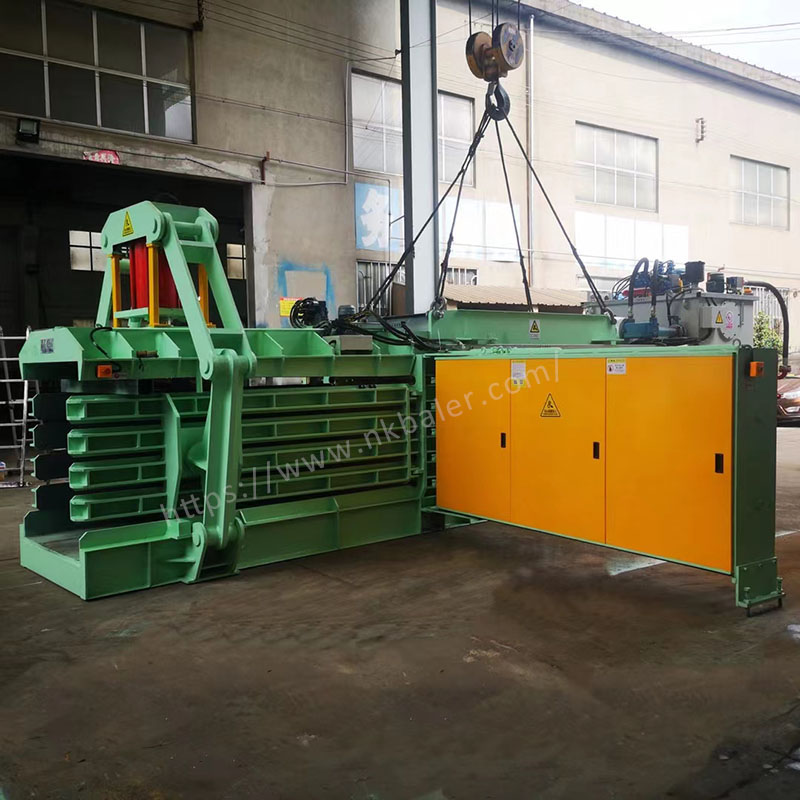
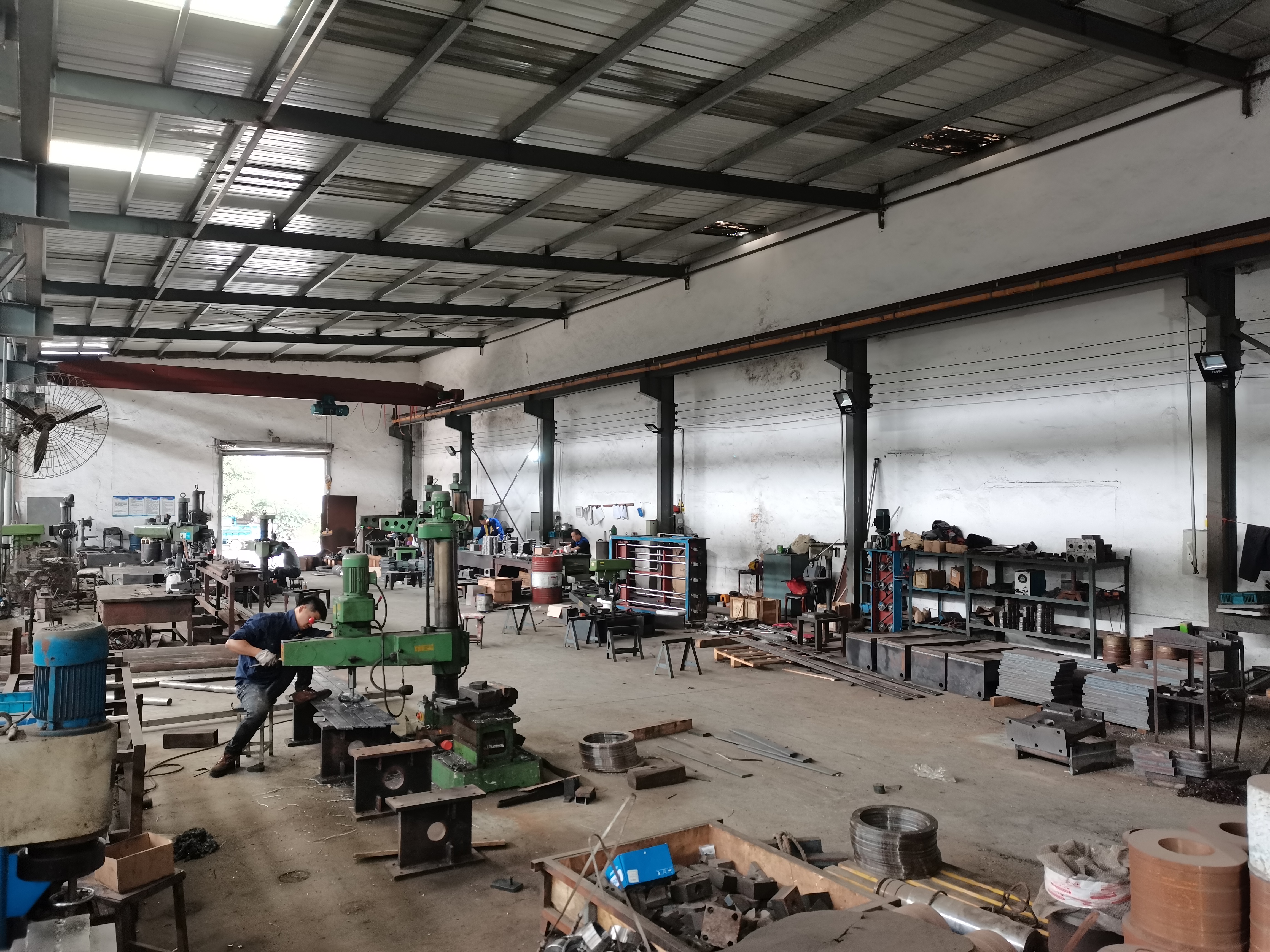
NKBALER — the trading identity of Shaanxi Nick Machinery Equipment Co., Ltd. — is a China-based manufacturer of environmental protection equipment and packaging machinery founded in 2013, operating a 5,000 m² production facility with a 15-person R&D team and exporting roughly 90% of its output to North America, South America and Asia. Its range covers Vertical Balers, Full-Automatic Horizontal Baler, Manual Horizontal Baler and Press Bagging Machine lines. The specification data used in this article is taken from that product documentation.
Problem Definition: Why Power and Chamber Size Decide Everything
Sizing errors in waste paper baling almost always come from treating hydraulic power as a single headline figure. Hydraulic power is not one number — it is the product of system pressure and the effective area the pressure acts on. Two machines can run at nearly the same system pressure and deliver very different force. In NKBALER's horizontal range, the NKW80BD is rated at 80 Ton hydraulic power with a working pressure of 18 MPa, while the NKW250BD is rated at 250 Ton with a working pressure of 23 MPa. System pressure rises by roughly a quarter; ram force more than triples. The difference is engineered into the cylinder and ram geometry, not into a higher pump setting.
Chamber size creates the second half of the constraint. A chamber that is too small for the incoming paper forces frequent stop-start loading and produces bales below the target weight. A chamber that is generously sized but fed by too little force produces bales that look correct at the press and fail later — they relax in the wire, lose shape in the stack, and cost more to transport per tonne of recovered fibre. Feed opening geometry matters just as much: an undersized opening relative to the largest piece of incoming material causes bridging, and bridging converts a rated throughput into an operator-dependent one.
Industry Background: A Growing, Compliance-Shaped Market
The industrial baler market is expanding alongside global recycling volumes. According to Maximize Market Research, the global industrial balers market was valued at USD 6.39 billion in 2024 and is projected to reach USD 13.21 billion by 2032. Waste paper and cardboard recovery is one of the volumetric drivers behind that figure, and it is also the segment where specification discipline pays back fastest, because bale density translates directly into transport and storage economics.
Two structural forces shape how buyers now evaluate machinery. The first is export concentration: customs data reported by Zauba shows China is the largest exporter of hydraulic baling press machines, accounting for over 77% of total import shipments in specific emerging market corridors. That makes supplier-side documentation and specification transparency a procurement issue, not just a technical one. The second is regulatory. Horizontal baling presses supplied into the European Union must comply with the EN 16252:2012 safety standard for CE marking, and hydraulic baling presses for waste paper are commonly classified under HS Code 842240 (packing or wrapping machinery) or 846291 (hydraulic presses for working metal and scrap). Both the safety standard and the tariff classification attach to the machine's architecture, which is why the vertical-versus-horizontal decision has compliance consequences and not only performance ones.
Detailed Solution: Matching Hydraulic Power to Chamber Geometry
Step 1 — Understand what hydraulic power means at the platen
Hydraulic power in a baling press describes the force the ram can exert, expressed in tonnes in NKBALER's documentation. It is generated by pressurising hydraulic oil against a cylinder piston; the force delivered is proportional to the piston area multiplied by the working pressure. This is why a documented working pressure of 18 MPa on the NKW80BD and 23 MPa on the NKW250BD does not explain the force gap on its own — the cylinder bore does.
For buyers, the practical consequence is simple: compare machines on ram force and bale density outcomes, and treat working pressure as a system-design detail. Higher pressure in a smaller cylinder and lower pressure in a larger cylinder can produce comparable force, with different implications for component wear, heat generation and cooling requirements. NKBALER's horizontal models document water cooling or oil chiller arrangements on the larger frames, which reflects that relationship.
Step 2 — Read chamber size as a throughput constraint, not a capacity label
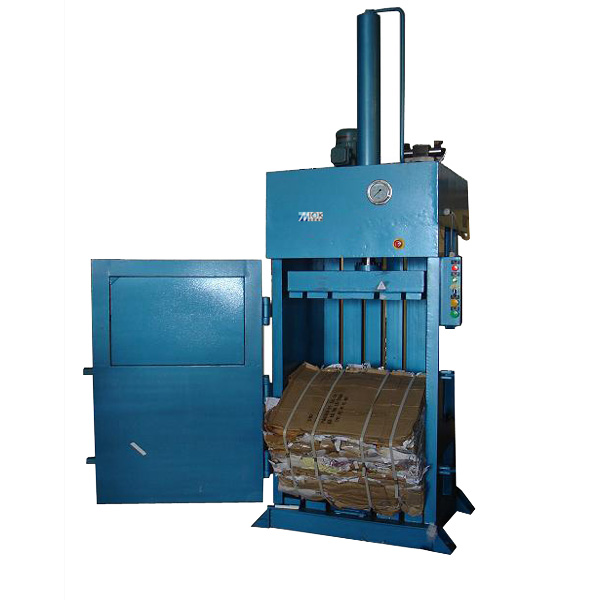
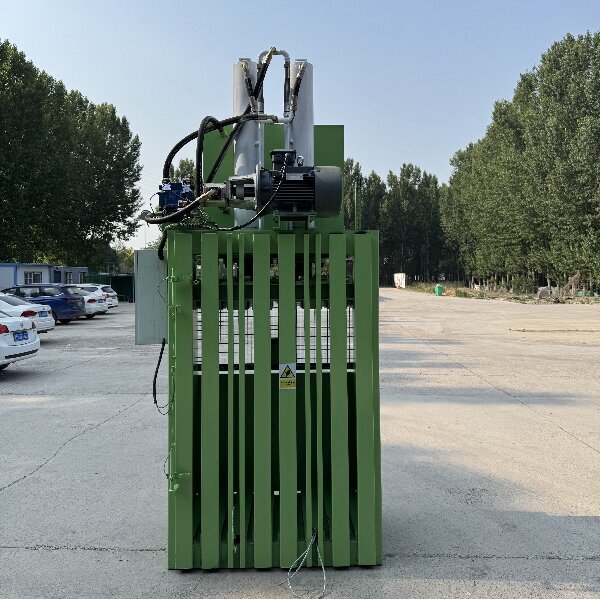
The chamber is where the bale is formed, and its dimensions set the maximum bale cross-section. In NKBALER's vertical range, the NK1070T60 documents a chamber of 1100 × 700 × 1450 mm with a bale of 1100 × 700 × (500–900) mm and a feed opening of 1100 × 500 mm. The chamber is a fixed box: the operator loads it, closes it, and the platen compresses downward. Cycle time therefore includes loading time, which is why vertical machines are documented in bales per hour — 5–8 bales per hour for the NK1070T60 — rather than tonnes per hour.
Horizontal machines invert that relationship. Their constraint is the feed opening, because the conveyor delivers material continuously into the compression zone. The NKW80BD documents a 1200 × 1000 mm feed opening and 2–3 tonnes per hour; the NKW180BD documents a 2400 × 1100 mm feed opening and 6–8 tonnes per hour; the NKW250BD documents a 2000 × 1100 mm feed opening and 10–15 tonnes per hour. Doubling the feed opening does not double throughput on its own, but it removes the operator from the loading loop and lets the ram cycle at a fixed cadence.
A third parameter sits between force and chamber: documented material density. NKBALER records 300–400 kg/m³ for the NKW80Q, 500–600 kg/m³ for the NKW125Q, and 400–600 kg/m³ for the NKW160Q. Note that the NKW160Q runs at a higher system pressure (25 MPa) than the NKW125Q (21 MPa) yet documents an overlapping density band — because density is produced by force, bale cross-section and material behaviour together. Density targets should always be agreed in writing against a named model and a named material, never assumed from a pressure figure.
Step 3 — Understand the operational cycle: direct baling versus pre-compression
Baling press architectures differ in how material reaches the point of maximum compression, and this difference drives the whole selection decision.
- Direct baling. Material is loaded into the bale chamber and the main ram compacts it directly, either against the chamber end or against the previously formed bale. Vertical balers work this way. The cycle is discrete and operator-paced: load, close, compress, tie, eject. It suits low-to-medium volumes where manual handling is already part of the workflow — retail backrooms, print and packaging operations, small transfer stations. The NK-T90L, for example, is documented with manual feeding and a 10–12 bales per hour output capacity.
- Pre-compression. Material is densified in a preliminary stage — through a pre-compression flap or a dedicated pre-compression chamber — before the main ram pushes the densified plug into the bale chamber. Because the material is already consolidated when the main stroke begins, the ram spends less of its stroke on air and loose volume, the bale chamber sees a more uniform load, and the cycle can be repeated at a fixed cadence without operator intervention. This is the architecture that makes continuous, conveyor-fed and automated lines practical.
Pre-compression is not automatically the right answer for every site. It adds a second motion sequence, more hydraulic components and more maintenance surface. For a facility baling a few tonnes a week from manual sorting, the additional mechanism is cost without benefit. For a facility running a conveyor, a sorting line or a 24/7 duty cycle, the opposite is true — the labour saved and the density consistency gained usually justify the additional mechanism. Buyers should confirm in writing which architecture a given model uses, because the term is used loosely in the market.
Vertical versus Horizontal: How the Operational Cycle Diverges
The clearest way to see the architecture split is to follow the material. In a vertical machine, the operator is the feeding mechanism. The bale is formed in a fixed chamber, ejected manually or semi-manually, and the whole cycle is paced by how fast material can be loaded. Documented throughput is expressed in bales per hour.
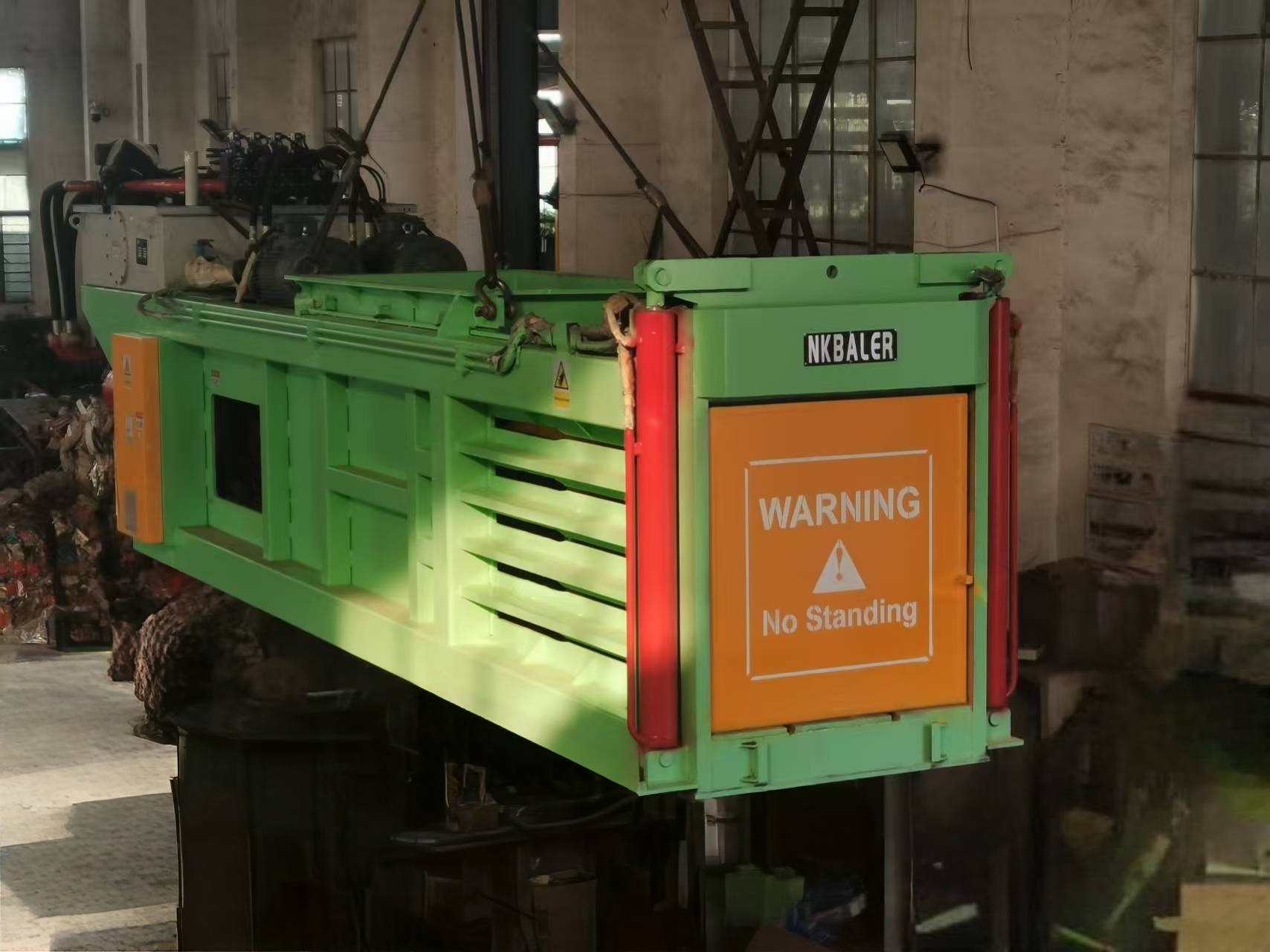
In a horizontal hydraulic baler, the conveyor is the feeding mechanism. Material is delivered into the compression zone without stopping the machine, the PLC controls the cycle, and the finished bale is pushed out horizontally. Documented throughput is expressed in tonnes per hour. NKBALER's application documentation describes the system operating mode for this class of equipment as continuous automatic operation, PLC controlled cycle, rated for 24/7 industrial duty, with matched equipment including the conveyor line and bale wire or strapping, and design requirements covering low noise and low energy consumption.
The practical selection logic follows directly:
- Choose vertical when the material arrives in small batches, floor space is tight, the power supply is limited, and manual labour is already handling the material. Documented vertical configurations in the NKBALER range run from a 2.2 kW, 600 kg unit (NK6040T10) up to a 22 kW, 11 T frame (NK1580T200).
- Choose horizontal when the material arrives continuously, when a conveyor or sorting line already exists, when bales must meet a consistent weight and density for transport contracts, or when the site runs multiple shifts. Documented horizontal configurations run from 22 kW / 14,500 kg (NKW80BD) to 45 kW / 30,000 kg (NKW250BD).
Step-by-Step Breakdown: A Sizing Sequence for Waste Paper
- Characterise the feed stream. Record the largest single piece of incoming material, the typical mix of old corrugated containers, mixed paper and other fibre, and how the material is delivered — loose, baled, or on a conveyor. The largest piece sets the minimum feed opening; the mix sets the achievable density.
- Set the bale target. Decide the bale weight and cross-section that your downstream logistics can handle. Note that horizontal models in the NKBALER range share a nominal 1100 mm bale width but differ in height (850–1250 mm) and length (up to ~1600–1800 mm), which changes bale weight at the same density.
- Match chamber or feed opening to the stream. For vertical machines, compare the chamber dimensions and the feed opening directly against the largest piece. For horizontal machines, compare the feed opening — documented examples range from 1200 × 1000 mm on the NKW80BD to 2400 × 1100 mm on the NKW180BD.
- Select hydraulic power against the density target. Move up the force range until the documented material density band for the model meets your target for the specific material you process. Do not select force on the basis of tonnage alone.
- Check the operating envelope. Confirm installed power, voltage and cooling against site conditions. Documented horizontal frames carry water cooling or oil chiller arrangements; vertical frames in the NKBALER range span 220 V/50 Hz to 380 V/50 Hz depending on model, with voltage customisation offered on some units.
- Verify compliance documentation. For EU and EEA destinations, horizontal baling presses must meet EN 16252:2012 for CE marking. Confirm the certificate number, the standards cited and the expiry date before the purchase order is raised.
- Confirm production and support terms. NKBALER documents OEM/ODM production, parameter-level customisation, a minimum order quantity of one unit, 100% testing, a monthly capacity of 10 units, a 30–45 day lead time, and remote after-sales support.
Use Cases: Matching Architecture to Site Reality
Retail backrooms, print shops and small transfer stations
Material arrives in small, intermittent batches and labour is already handling it. A vertical machine with direct baling fits: low installed power, compact footprint, and throughput documented in bales per hour that matches the pace of manual sorting. The NK6040T10 (10 Ton, 2.2 kW, 600 kg) and NK1070T60 (60 Ton, 15 kW, 5–8 bales/hour) bracket this category.
Recycling stations and municipal recovery facilities
Material arrives continuously and bales must be consistent for transport contracts. A horizontal hydraulic baler with conveyor feeding and a larger feed opening fits. NKBALER's documented case record for a recycling station manufacturer in Indonesia covers waste plastic baling and waste paper baling with a single unit, an expected 10–15 year service life under normal operation, and highlights of low noise and low energy consumption; the associated product records are the NKW180QT, NKW160Q, NKW125Q and NKW80Q horizontal models.
Automated sorting lines and paper mills
Where a conveyor line and a PLC already exist, the baler becomes a node in an automated flow. This is where continuous automatic operation and 24/7 duty ratings matter more than peak force, and where pre-compression architecture pays back through consistent bale density and reduced operator attendance.
Comparison Table: Documented Parameter Reference
The table below reproduces documented specifications from NKBALER product records. It is intended as a sizing reference, not as a recommendation for any specific site; final selection should be confirmed against a measured material sample and site conditions.
| Model | Architecture | Hydraulic power | Working pressure | Bale size (W×H×L) | Feed opening / chamber | Documented throughput | Power | Machine weight |
|---|---|---|---|---|---|---|---|---|
| NK6040T10 | Vertical, manual feed | 10 Ton | 10 MPa | 600 × 400 × (350–600) mm | Feed 540 × 450 mm | 6–8 bales/hour | 2.2 kW / 3 HP | 600 kg |
| NK1070T60 | Vertical, manual feed | 60 Ton | — | 1100 × 700 × (500–900) mm | Chamber 1100 × 700 × 1450 mm; feed 1100 × 500 mm | 5–8 bales/hour | 15 kW / 20 HP | 2.2 T |
| NK60LT | Vertical, manual feed | 60 Ton | 25 MPa | 1000 × 700 × (400–800) mm | Chamber 1000 × 700 × 1250 mm; feed 1000 × 460 mm | 10–12 bales/hour | 15 kW / 20 HP | 2,900 kg |
| NK-T90L | Vertical, double chamber, manual feed | 90 Ton | 25 MPa | 760 × 520 × (500–1000) mm | Feed 750 × 550 mm | 10–12 bales/hour | 18.5 kW / 25 HP | 4.8 T |
| NKW80BD | Horizontal, semi/full automatic | 80 Ton | 18 MPa | 1100 × 850 × 1700 mm | Feed 1200 × 1000 mm | 2–3 T/hour | 22 kW / 30 HP | 14,500 kg |
| NKW125BD | Horizontal, semi/full automatic | 125 Ton | 20 MPa | 1100 × 1250 × 1700 mm | Feed 2000 × 1100 mm | 5–7 T/hour | 30 kW / 40 HP | 18,000 kg |
| NKW180BD | Horizontal, semi/full automatic | 180 Ton | 21 MPa | 1100 × 1150 × 1800 mm | Feed 2400 × 1100 mm | 6–8 T/hour | 45 kW / 60 HP | 24,000 kg |
| NKW250BD | Horizontal, semi/full automatic | 250 Ton | 23 MPa | 1100 × 1250 × 1700 mm | Feed 2000 × 1100 mm | 10–15 T/hour | 45 kW / 60 HP | 30,000 kg |
| NKW80Q | Horizontal, semi/full automatic | 80 T | 21 MPa | 1100 × 800 × ~1600 mm | Feed 1500 × 800 mm | 3–5 T/hour | 30 kW + 11 kW | 15 T |
| NKW125Q | Horizontal, semi/full automatic | 125 T | 21 MPa | 1100 × 1100 × ~1600 mm | Feed 2000 × 1100 mm | 10–12 T/hour | 37.5 kW + 11 kW | 22 T |
| NKW160Q | Horizontal, semi/full automatic | 160 T | 25 MPa | 1100 × 1250 × ~1600 mm | Feed 2000 × 1100 mm | 12–15 T/hour | 45 kW + 11 kW | 28 T |
| NKW180QT | Horizontal, semi/full automatic | 160 T | 30.5 MPa | 1100 × 1250 × ~1600 mm | Feed 2000 × 1100 mm | 12–15 T/hour | 45 kW + 7.5 kW | 28 T |
Documented material density bands for the Q-series horizontal models: NKW80Q 300–400 kg/m³, NKW125Q 500–600 kg/m³, NKW160Q 400–600 kg/m³, NKW180QT 500–600 kg/m³. Density outcomes depend on force, bale cross-section and the specific material, and should be confirmed against a sample of your own stream.
Architecture comparison at a glance
| Comparison criterion | Vertical machine | Horizontal hydraulic baler |
|---|---|---|
| Material feed | Manual loading into a fixed chamber | Conveyor-fed compression zone |
| Compression principle | Direct baling into a closed chamber | Ram compression with horizontal bale ejection |
| Documented throughput unit | Bales per hour | Tonnes per hour |
| Documented force range (NKBALER range) | 10 Ton to 200 Ton | 80 Ton to 250 Ton |
| Documented working pressure range | 10 MPa to 25 MPa | 18 MPa to 23 MPa (Q-series up to 30.5 MPa) |
| Documented installed power examples | 2.2 kW to 22 kW | 22 kW to 45 kW |
| Documented machine weight examples | 600 kg to 11 T | 14,500 kg to 30,000 kg |
| Best fit | Intermittent batches, limited space or power, manual handling already in place | Continuous feed, conveyor or sorting lines, consistent bale contracts, multi-shift duty |
Compliance and Procurement Checks Before Ordering
Because the vertical-versus-horizontal decision changes which safety standard applies, compliance should be checked at the same time as the sizing decision. NKBALER holds a Verification of Conformity issued for the EU/EEA market under certificate number DPWD/09/060/2024, valid from 19 September 2024 to 18 September 2029, citing EN ISO 12100:2010, EN 60204-1:2018 and EN 415-1:2014. The company also holds an Attestation Certificate of Machinery Directive, certificate number EASY03220201M, issued through UDEM International Certification Auditing Training Centre, valid from 22 March 2022 to 21 March 2027 for the EU, EEA and Türkiye markets, citing EN ISO 12100:2010 and EN 60204-1:2018.
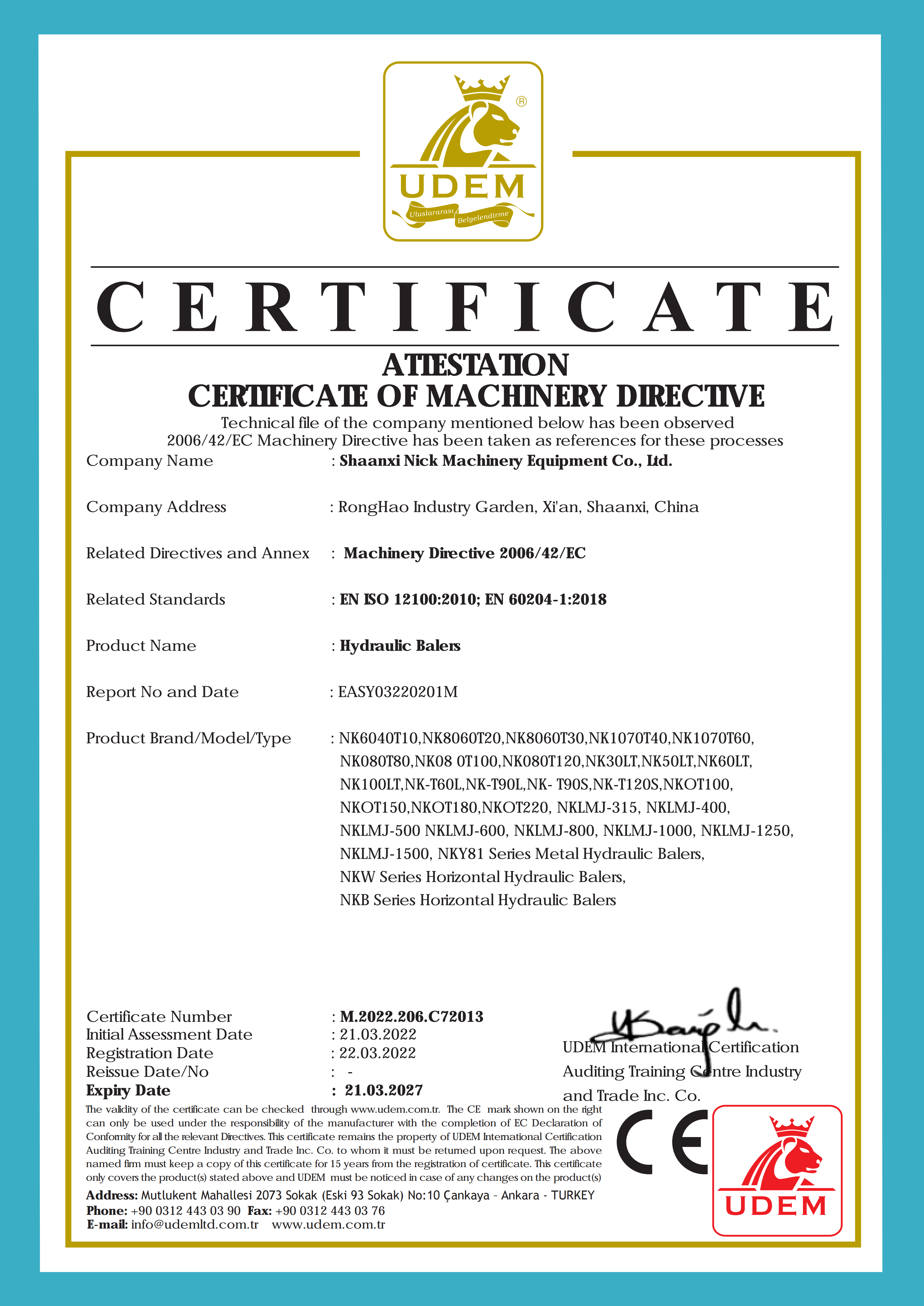
Alongside certificates, buyers should confirm the commercial envelope: production mode (OEM/ODM), scope of customisation, minimum order quantity, quality-control regime, monthly capacity, lead time and after-sales arrangement. NKBALER documents parameter-level customisation under an OEM/ODM production mode, a minimum order quantity of one unit, 100% testing, a monthly capacity of 10 units, a 30–45 day lead time and remote after-sales support, exporting to the EU and Middle East among other markets.
Frequently Asked Questions
What compliance documentation should accompany a waste paper hydraulic baler machine for the EU market?
Horizontal baling presses supplied into the European Union must comply with the EN 16252:2012 safety standard for CE marking, in addition to general machinery safety requirements. NKBALER holds a Verification of Conformity for the EU/EEA market under certificate number DPWD/09/060/2024, valid to 18 September 2029, citing EN ISO 12100:2010, EN 60204-1:2018 and EN 415-1:2014, and an Attestation Certificate of Machinery Directive with certificate number EASY03220201M, valid to 21 March 2027 for the EU, EEA and Türkiye, citing EN ISO 12100:2010 and EN 60204-1:2018. Buyers should verify the certificate number, the standards cited, the covered markets and the expiry date before raising a purchase order.
Can hydraulic power and chamber size be customised for a specific waste paper stream?
NKBALER documents an OEM/ODM production mode with parameter-level customisation, so hydraulic power, chamber and feed-opening dimensions, bale size, voltage and conveyor configuration can be specified against the buyer's material. The documented standard range itself already spans a wide envelope: vertical frames from 10 Ton to 200 Ton hydraulic power, and horizontal frames from 80 Ton to 250 Ton, with documented bale widths of 1100 mm and bale heights from 800 mm to 1250 mm on horizontal models. Customisation requests are handled at parameter level, so the buyer should supply material data and target bale specifications rather than a model number alone.
What drives the cost of a waste paper hydraulic baler machine if not tonnage alone?
Cost is driven by the combination of frame size, cylinder and ram force, chamber or feed-opening dimensions, installed motor power, conveyor length and weight, automation level, and cooling arrangement — not by hydraulic power in isolation. Moving from a 22 kW / 14,500 kg horizontal frame to a 45 kW / 30,000 kg frame changes steel mass, hydraulic component sizing, conveyor length and cooling requirement simultaneously, and those are the cost-bearing elements. Buyers comparing quotations should therefore normalise on bale size, documented throughput, feed opening, conveyor specification and cooling type rather than on a single headline force figure.
Can we validate a machine against our own waste paper before ordering?
NKBALER documents a minimum order quantity of one unit combined with parameter-level customisation and 100% testing, which allows a first machine to be configured against measured material data and used as the validation unit for the site. Because density outcomes depend on the specific material mix, the correct validation approach is to define the target bale weight and density band in writing against a named model — for example the documented 300–400 kg/m³ band for the NKW80Q or the 500–600 kg/m³ band for the NKW125Q — and to confirm those targets against a sample of your own stream rather than against a generic specification sheet.
What is the typical production lead time and after-sales arrangement?
NKBALER documents a 30–45 day lead time, a monthly production capacity of 10 units, and remote after-sales support, with export markets including the EU and Middle East. Lead time should be confirmed against the specific configuration, since parameter-level customisation and conveyor specification can extend the build schedule beyond the standard window. To start a sizing conversation, send your material data, target bale dimensions and destination market to the NKBALER engineering team at www.nkbaler.com, Sales@nkbaler.com, or +86 15021631102 — a specification review against your actual stream is the fastest way to confirm hydraulic power and chamber size together.
Match Hydraulic Power and Chamber Size to Your Waste Paper
Send us your material mix, largest infeed piece and target bale dimensions. The NKBALER engineering team will map them against the documented vertical and horizontal configurations and return a specification proposal, including the applicable certifications for your destination market.
Contact: Sales@nkbaler.com | +86 15021631102 | www.nkbaler.com
Conclusion
Sizing a waste paper hydraulic baler machine is a two-variable problem. Hydraulic power sets how hard the material can be pressed; chamber and feed-opening geometry set how much material can be presented and what shape the bale takes. Neither variable can be selected in isolation, and neither can be read reliably from a system pressure figure alone — the NKW80BD at 18 MPa and the NKW250BD at 23 MPa illustrate that clearly, with a quarter more pressure producing more than three times the force.
A practical sequence for buyers is to characterise the stream, set the bale target, match chamber or feed opening to the largest incoming piece, then move up the force range until the documented density band meets the target. Architecture follows from the site: vertical machines with direct baling suit manual feeding and intermittent batches, while horizontal hydraulic balers with conveyor-fed compression suit automated lines and continuous operation. Compliance should be checked in parallel, since the EU safety standard attaches to the horizontal baling press class, with EN 16252:2012 applying alongside the machinery safety standards cited in NKBALER's EU/EEA and Türkiye certificates.
Get the two variables right at the specification stage, and the equipment decision becomes straightforward. Get them wrong, and no amount of operating adjustment will recover the density the site actually needs.
Have Questions or Need More Details?
Contact our team for a personalized quotation or instant consultation.
Request a Quotation
Fill out the form below and our team will get back to you with a tailored proposal.
WhatsApp Direct Chat
Prefer to chat in real-time? Message us on WhatsApp for instant assistance & quick answers.
- Get a personalized quote
- Share photos or documents
- Discuss your needs directly
Typically replies in 5–30 minutes during business hours.