
How to Match a Waste Paper Hydraulic Baler to Your Facility: A Setup Application Guide
Matching a waste paper hydraulic baler machine to a facility is a three-measurement exercise: how many tonnes of waste paper the site produces per shift, how much floor and ceiling space the machine is allowed to occupy, and how material arrives at the baler and leaves it. Vertical machines handle intermittent volume in tight footprints, horizontal hydraulic balers handle continuous lines, and constant-weight bagging machines take over when the output must leave as a fixed-weight packaged unit rather than a wire-tied bale.
This guide is written for facility managers and procurement teams evaluating a first or replacement waste paper baling setup. It walks through the equipment families offered by NKBALER — the brand of Shaanxi Nick Machinery Equipment Co., Ltd., a manufacturer established in 2013 in Wuxi, Jiangsu Sheng, China, engaged in the R&D and sales of environmental protection equipment and packaging machinery, with approximately 90% of products exported to markets in North America, South America and Asia — and then converts that range into a step-by-step matching sequence and a purchasing checklist.
The objective is not to recommend a single machine. It is to supply the dimensions, capacities and questions that decide which configuration actually fits a specific site.
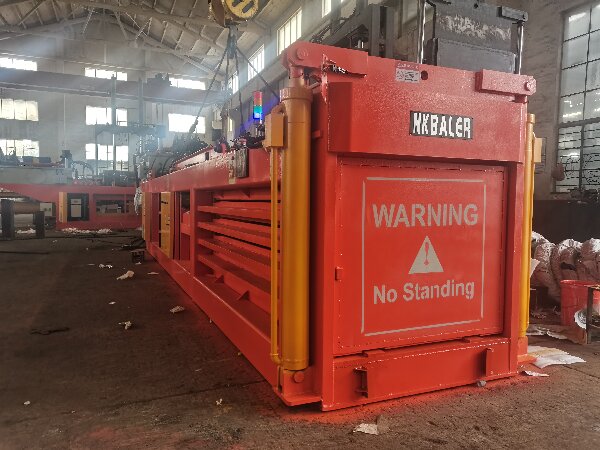
Why Baling Setups Go Wrong Before Delivery
Most mismatches are not hydraulic failures. They are layout and material-flow decisions that only become visible after the machine is installed. Five patterns repeat:
- Sizing on peak volume instead of sustained volume. A baler selected for the busiest week of the year runs below its rated capacity for the rest of it, while a baler selected below the feed rate creates a permanent queue at the chamber.
- Feed opening versus press speed. A press that cycles quickly still cannot accept material faster than its feed opening allows, and an undersized opening forces pre-cutting or sorting labour.
- Foorprint and height ignored. Vertical machines stand tall and narrow; horizontal machines spread wide and carry conveyors. Headroom and travel paths decide the outcome as much as tonnage does.
- Bale format chosen without the handling behind it. Bale size, bale weight and wire specification determine how bales are stacked, loaded and sold.
- Utilities and downstream packaging treated as an afterthought. Voltage, connected power, cooling arrangement and whether the material leaves as a bale or as a bag are all configuration inputs, not installation details.
What the Market and the Standards Require
Maximize Market Research valued the global industrial balers market at USD 6.39 billion in 2024 and projects it to reach USD 13.21 billion by 2032, which reflects a equipment class expanding alongside waste volumes rather than contracting. For buyers, the more immediate context is regulatory and customs-driven.
Horizontal baling presses intended for the European Union must comply with EN 16252:2012 — BS EN 16252:2012 in the UK — covering safety requirements for machines that compact waste materials, as published by BSI Knowledge, in order to carry CE marking. On the trade side, hydraulic baling press machines are commonly classified under HS code 842240 (packing or wrapping machinery) or 846291 (hydraulic presses), according to customs datasets compiled by Volza and Made-in-China. Customs data for specific emerging-market import corridors shows China as the largest exporter of hydraulic baling press machines, accounting for over 77% of shipments in those corridors (Zauba customs data).
For a facility still at the awareness and research stage, the practical implication is that a shortlist is decided by three things: what the machine must process, where it must live, and what documentation the destination market demands. Capacity tables come after those three are settled.
The Three Equipment Families and the Jobs They Fit
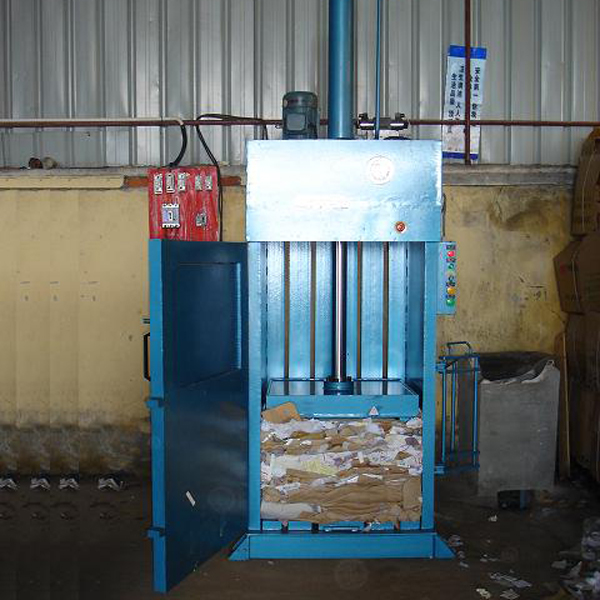
Vertical machines: intermittent volume, minimal footprint
Vertical balers compress material in a tall chamber and produce smaller, denser bales from a very small floor area. In the NKBALER range, the NK6040T10 is a 10-ton waste paper baler with a packaging size of 600 × 400 × (350–600) mm and a bale weight of 50–80 kg, rated at 6–8 bales per hour. It operates on 220 V/50 Hz with 2.2 kW of power, occupies 870 × 780 × 2,150 mm and weighs 600 kg. That combination of single-phase supply and sub-square-metre footprint is what makes it usable at a collection point that has no three-phase power and no spare floor.
The NK1070T60 is a 60-ton cardboard box baler machine with a bale size of 1100 × 700 × (500–900) mm, a chamber of 1100 × 700 × 1450 mm and a feed opening of 1100 × 500 mm. It is rated 5–8 bales per hour, powered at 15 kW/20HP on 380 V/50 Hz, measures 1,600 × 1,100 × 3,200 mm and weighs 2.2 tonnes. The 3.2 metre height is the first number to check against the ceiling, not the last.
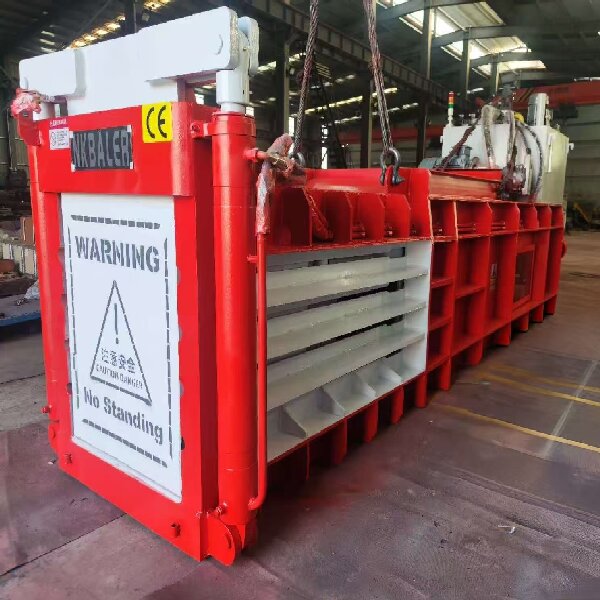
Horizontal hydraulic balers: continuous throughput, conveyor feed
Horizontal machines trade floor area for throughput. They accept material through a large feed opening or a conveyor, and they are specified in tonnes per hour rather than bales per hour. The NKBALER horizontal range runs from an 80-ton entry class to a 250-ton high-volume class, and the spread of capacity figures is what makes site matching possible:
- NKW80BD — 80 tons hydraulic power, bale size 1100 × 850 × 1700 mm, feed opening 1200 × 1000 mm, capacity 2–3 t/hour, 22 kW/30HP, bale wire 10# × 4 pcs, machine weight 14,500 kg.
- NKW80Q — 80-ton main cylinder force, bale size 1100 × 800 × ~1600 mm at a material density of 300–400 kg/m³, feed opening 1500 × 800 mm, main motor 30 kW + 11 kW, capacity 3–5 t/hour, mainframe weight 15 tons, mainframe about 9.8 × 4.3 × 1.4 m, conveyor 1,200 mm × 12,000 mm with a 4 kW motor.
- NKW125BD — 125 tons hydraulic power, bale size 1100 × 1250 × 1700 mm, feed opening 2000 × 1100 mm, capacity 5–7 t/hour, 30 kW/40HP, bale wire 10# × 5 pcs, machine weight 18,000 kg, conveyor 12,000 × 1,800 mm with a 4.5 kW motor.
- NKW125Q — 125-ton main cylinder force, bale size 1100 × 1100 × ~1600 mm at a material density of 500–600 kg/m³, feed opening 2000 × 1100 mm, main motor 37.5 kW + 11 kW, capacity 10–12 t/hour, mainframe weight 22 tons, conveyor 2,000 × 12,000 mm with a 7.5 kW motor.
- NKW160Q — 160-ton main cylinder force, bale size 1100 × 1250 × ~1600 mm at a material density of 400–600 kg/m³, feed opening 2000 × 1100 mm, main motor 45 kW + 11 kW, capacity 12–15 t/hour, mainframe weight 28 tons, conveyor 2,000 × 14,000 mm with a 7.5 kW motor.
- NKW180QT — 160-ton main cylinder force, bale size 1100 × 1250 × ~1600 mm at a material density of 500–600 kg/m³, feed opening 2000 × 1100 mm, main motor 45 kW + 7.5 kW, capacity 12–15 t/hour, mainframe about 13 × 4.3 × 5.8 m, conveyor 2,000 × 12,000 mm with a 4 kW motor, and a cooling tower rated 0.75 kW (water pump) + 0.25 kW (fan).
- NKW180BD — 180 tons hydraulic power, bale size 1100 × 1150 × 1800 mm, feed opening 2400 × 1100 mm, capacity 6–8 t/hour, 45 kW/60HP, bale wire 6#/8# × 5 pcs, machine weight 24,000 kg, chain steel conveyor 5.5 kW motor at 14,000 × 2,000 mm.
- NKW250BD — 250 tons hydraulic power, bale size 1100 × 1250 × 1700 mm, feed opening 2000 × 1100 mm, capacity 10–15 t/hour, 45 kW/60HP, bale wire 6#/8# × 5 pcs, machine weight 30,000 kg, conveyor 12,000 × 2,000 mm with a 4.5 kW motor and a conveyor weight of 5,000 kg.
Models in this family are specified as fully automatic horizontal hydraulic balers or semi-automatic horizontal hydraulic balers, and the automation level is one of the parameters that changes labour allocation rather than throughput class.
Press bagging machines: when the output leaves in bags
Not every waste handling workflow ends in a strapped bale. Constant-weight bagging machines produce fixed-weight packaged units instead, and they are specified by bale dimensions and unit weight rather than tonnes per hour:
- NKB20 — constant weight bagging machine with a bale size of 750 × 400 × 330 mm and a bale weight of 20 kg, 380 V/50 Hz, 15 kW/20HP, machine weight 950 kg.
- NKB10 — constant weight bagging machine with a bale size of 200 × 130 × 100 mm and a bale weight of 1–1.5 kg, 380 V/50 Hz, 18.5 kW/25HP, machine size 3,800 × 2,500 × 2,100 mm, machine weight 2,400 kg.
Two further configurations in the same product family are built for fibrous and higher-moisture streams rather than waste paper, and they should be matched on that basis. The NKB220 block making machine runs at 200 tons with 480 × 480 × (220–350) mm bales, 21 MPa working pressure, a 22-second compress time, 90 blocks per hour, a moisture requirement of 13% or under, 30–35 kg per bag, 2.5–3 t/hour capacity, 200–480 V/50 Hz/3-phase and 40HP, on a 4,260 × 1,100 × 1,800 mm frame weighing 6 tonnes. The NKB280 straw/hay bagging machine produces 1100 × 1200 × 800 mm bales from a 2600 × 1200 mm feed opening, handling alfalfa, wheat straw and peanut hay at 30–32 bales per hour, 400–450 kg dry bale weight and 10–12 t/hour, with 45 kW × 2 power, a chain conveyor and a machine weight of 32,000 kg.
Step-by-Step: Matching a Machine to Your Site
Step 1 — Convert waste paper volume into a capacity class
Work from tonnes per shift, not bins per day. Weigh or estimate the material produced on a normal operating day, divide by the hours available for baling, and compare the result against the rated capacity bands: 2–3 t/hour (NKW80BD), 3–5 t/hour (NKW80Q), 5–7 t/hour (NKW125BD), 6–8 t/hour (NKW180BD), 10–12 t/hour (NKW125Q), 12–15 t/hour (NKW160Q and NKW180QT), and 10–15 t/hour (NKW250BD). For vertical configurations the unit changes to bales per hour: 6–8 for the NK6040T10 and 5–8 for the NK1070T60.
Step 2 — Map the footprint before the machine arrives
Note three dimensions: mainframe footprint, conveyor length if the model is conveyor-fed, and overhead clearance. The NK6040T10 needs 870 × 780 mm of floor and 2,150 mm of height. The NK1070T60 needs 1,600 × 1,100 mm and 3,200 mm of height. The NKW80Q mainframe measures about 9.8 × 4.3 × 1.4 m with a 1,200 × 12,000 mm conveyor. The NKW180QT mainframe measures about 13 × 4.3 × 5.8 m and includes a cooling tower. Those figures, not the tonnage rating, usually decide whether a site can take the machine at all.
Step 3 — Decide how material reaches the chamber
Feed openings in the range run from 540 × 450 mm (NK6040T10) and 1100 × 500 mm (NK1070T60) through 1200 × 1000 mm (NKW80BD) and 1500 × 800 mm (NKW80Q) to 2000 × 1100 mm (NKW125BD, NKW125Q, NKW160Q, NKW180QT, NKW250BD) and 2400 × 1100 mm (NKW180BD). A larger opening accepts bulky cardboard without pre-cutting; a conveyor-fed model moves labour away from the chamber and into sorting, which changes staffing more than it changes tonnage.
Step 4 — Fix the bale format and the handling behind it
Bale size determines transport and stacking; bale wire determines consumable planning. The range specifies 10# × 4 pcs on the NKW80BD, 10# × 5 pcs on the NKW125BD, and 6#/8# × 5 pcs on the NKW180BD and NKW250BD. Bale weights run from 50–80 kg on the NK6040T10 through 200–350 kg on the NK080T100 to 1,000–2,000 kg on the NK1580T200 vertical metal baler machine, so manual handling limits are part of the specification, not an operational detail.
Step 5 — Confirm utilities, cooling and the density assumption
A vertical NK6040T10 runs on 220 V/50 Hz at 2.2 kW. Horizontal models in the range run on 380 V/50 Hz at 22 kW to 45 kW, with cooling provided either by a cooling fan (NKW80BD, NKW125BD) or by water cooling or an oil chiller. Bagging units in the range are specified at 200–480 V/50 Hz/3-phase on the larger configurations. Density matters because capacity is quoted against it: 300–400 kg/m³ for the NKW80Q and 400–600 kg/m³ for the NKW160Q and NKW180QT. If your material bales at a different density, the throughput figure moves with it.
Step 6 — Decide whether the output is strapped or bagged
If bales are the sellable or shippable unit, stop at the baler. If the material must be repackaged — into uniform 20 kg units on the NKB20 or small 1–1.5 kg units on the NKB10 — then the bagging unit is part of the production line and needs its own floor space, power supply and downstream handling plan.
Step 7 — Write the acceptance criteria into the order
Configuration is only settled when the bale size, bale weight, capacity at a stated density, feed arrangement, utility data and documentation requirements are recorded in the purchase specification. The checklist in the next section is designed to be used as that document.
Three Facility Scenarios, Three Different Configurations
Scenario A: High-volume recycling line
A recycling or materials recovery facility receiving waste paper by conveyor at 12–15 t/hour is matching against the top of the horizontal range: NKW160Q, NKW180QT or NKW250BD. Three constraints dominate the decision at this scale. First, mainframe and conveyor length — the NKW180QT occupies roughly 13 × 4.3 × 5.8 m and needs cooling tower space. Second, cooling: continuous duty at this class is specified with water cooling or an oil chiller rather than a cooling fan alone. Third, consumables: bale wire at 6#/8# × 5 pcs per bale on the NKW180BD and NKW250BD must be planned against daily bale counts, and bales at 1,100 mm width by 1,250 mm height must fit the stacking and loading layout.
Scenario B: Space-constrained collection point
A retail back room, a small transfer station or a building with no three-phase supply is matching against the vertical range. The NK6040T10 fits in 870 × 780 mm of floor at 600 kg machine weight, runs from a 220 V/50 Hz supply at 2.2 kW, and produces 50–80 kg bales at 6–8 bales per hour. Where the stream is cardboard-heavy and headroom allows 3.2 m, the NK1070T60 doubles the output class to 5–8 bales per hour with bales up to 1100 × 700 × 900 mm, at the cost of a 380 V/50 Hz supply and 2.2 tonnes of machine weight.
Scenario C: Baling-plus-bagging workflow
Some operations need compaction and packaging in one flow, usually because the receiving process or the customer takes fixed-weight units rather than bales. In that case the baler is matched first — by tonnage, footprint and feed — and the bagging unit is matched second, by unit weight. The NKB20 produces 20 kg units from a 750 × 400 × 330 mm bale; the NKB10 produces 1–1.5 kg units from a 200 × 130 × 100 mm bale. Where the stream is not waste paper, the same matching sequence applies but the models change: the NK080T100 vertical machine handles cans and PET bottles at 100 tons hydraulic power with 1000 × 800 × (500–1000) mm bales of 200–350 kg at 3–6 bales per hour, and the NKOT150 handles tires at 150 tons with 1800 × 1000 × 700–1250 mm bales of 1,000–1,500 kg at 4–5 bales per hour. For fibrous streams with a moisture constraint, the NKB220 requires moisture at 13% or under.

Comparison Table: Matching Configuration to Facility Profile
| Facility profile and material flow | Machine family | Representative models | Stated capacity | Bale output | Footprint and utility signals |
|---|---|---|---|---|---|
| Small collection point, intermittent volume, limited floor, no three-phase supply | Vertical baler | NK6040T10 | 6–8 bales/hour | 600 × 400 × (350–600) mm; 50–80 kg | 870 × 780 × 2,150 mm; 600 kg; 220 V/50 Hz; 2.2 kW |
| Retail or warehouse back room, cardboard and waste paper, manual feed | Vertical baler | NK1070T60 | 5–8 bales/hour | 1100 × 700 × (500–900) mm; chamber 1100 × 700 × 1,450 mm | 1,600 × 1,100 × 3,200 mm; 2.2 t; 380 V/50 Hz; 15 kW/20HP |
| Continuous line, moderate tonnage, conveyor feed | Horizontal hydraulic baler | NKW80Q; NKW125BD | 3–5 t/hour; 5–7 t/hour | 1100 × 800 × ~1600 mm at 300–400 kg/m³; 1100 × 1250 × 1700 mm | Mainframe about 9.8 × 4.3 × 1.4 m, conveyor 1,200 × 12,000 mm, 4 kW; 18,000 kg with conveyor 12,000 × 1,800 mm, 4.5 kW |
| High-volume recycling line, 12–15 t/hour, continuous duty | Horizontal hydraulic baler | NKW160Q; NKW180QT; NKW250BD | 12–15 t/hour; 12–15 t/hour; 10–15 t/hour | 1100 × 1250 × ~1600 mm at 400–600 kg/m³; 1100 × 1250 × ~1600 mm at 500–600 kg/m³; 1100 × 1250 × 1700 mm | Conveyor 2,000 × 14,000 mm, 7.5 kW; mainframe about 13 × 4.3 × 5.8 m with cooling tower; 30,000 kg with conveyor 12,000 × 2,000 mm, 4.5 kW |
| Baling-plus-bagging workflow, fixed-weight output required | Press bagging machine | NKB20; NKB10 | Specified by unit weight rather than tonnage | 750 × 400 × 330 mm at 20 kg; 200 × 130 × 100 mm at 1–1.5 kg | 15 kW/20HP, 950 kg; 18.5 kW/25HP, 3,800 × 2,500 × 2,100 mm, 2,400 kg; 380 V/50 Hz |
| Fibrous or higher-moisture streams adjacent to waste paper handling | Block making and straw/hay bagging | NKB220; NKB280 | 2.5–3 t/hour and 90 blocks/hour; 10–12 t/hour and 30–32 bales/hour | 480 × 480 × (220–350) mm, 30–35 kg per bag; 1100 × 1200 × 800 mm, 400–450 kg dry | Moisture 13% or under, 21 MPa, 6 t; 200–480 V/50 Hz/3-phase, chain conveyor, 32,000 kg |
All figures in this table are taken from NKBALER product specifications. Capacity is stated at the material density given for each model; actual output depends on material preparation, moisture and operating practice.
Purchasing Terms and Acceptance Criteria Checklist
Use this list as the purchase specification. Each line is a configuration decision that cannot be corrected after delivery without cost.
- Bale target: length × width × height and target weight per bale, stated for your actual material — for example 1100 × 850 × 1700 mm on the NKW80BD or 1100 × 1250 × 1700 mm on the NKW250BD.
- Density assumption: the kg/m³ at which the capacity figure is quoted (300–400 kg/m³ on the NKW80Q; 400–600 kg/m³ on the NKW160Q; 500–600 kg/m³ on the NKW125Q and NKW180QT).
- Throughput: tonnes per hour or bales per hour at that density, not a peak figure.
- Feed arrangement: manual feed opening dimensions (540 × 450 mm to 2400 × 1100 mm across the range) or conveyor width, length and motor rating.
- Bale tying: wire specification and count per bale (10# × 4 on the NKW80BD; 10# × 5 on the NKW125BD; 6#/8# × 5 on the NKW180BD and NKW250BD).
- Utilities: voltage, phase, frequency and connected power (2.2 kW on the NK6040T10; 22–45 kW on horizontal models; 200–480 V/50 Hz/3-phase on larger bagging configurations).
- Cooling: cooling fan, water cooling or oil chiller, and the cooling tower footprint where applicable.
- Footprint drawing: mainframe dimensions plus conveyor, service clearance and overhead height — 2,150 mm on the NK6040T10, 3,200 mm on the NK1070T60, about 5.8 m on the NKW180QT mainframe.
- Documentation: HS code for customs clearance (8422.40 or 8462.91) and compliance with EN 16252:2012 for horizontal baling presses destined for the EU or UK.
- Acceptance test: run the agreed material and verify bale size, bale weight, achieved density, cycle time and wire consumption against the specification.
- Support terms: spare parts list, operator training, warranty and after-sales response arrangement.
FAQ
Which standards apply to a waste paper hydraulic baler machine?
For the European Union, horizontal baling presses fall under EN 16252:2012 — BS EN 16252:2012 in the UK — which sets safety requirements for machines that compact waste materials, and compliance is required for CE marking, according to BSI Knowledge. For customs, hydraulic baling press machines are commonly classified under HS code 842240 (packing or wrapping machinery) or 846291 (hydraulic presses), according to customs datasets published by Volza and Made-in-China. Voltage, phase and safety arrangements should always be confirmed against the destination market before the order is placed.
How do I decide between a vertical machine and a horizontal hydraulic baler?
Three numbers decide it. Capacity: vertical models in the NKBALER range are rated in bales per hour (6–8 for the NK6040T10; 5–8 for the NK1070T60), while horizontal models are rated in tonnes per hour, from 2–3 t/hour on the NKW80BD and 3–5 t/hour on the NKW80Q up to 12–15 t/hour on the NKW160Q and NKW180QT. Footprint: 870 × 780 × 2,150 mm for the NK6040T10 versus roughly 13 × 4.3 × 5.8 m for the NKW180QT mainframe. Feed: a manual feed opening of 540 × 450 mm to 1500 × 800 mm on vertical and small horizontal models, versus 2000 × 1100 mm or 2400 × 1100 mm with conveyor feed on high-volume horizontal models.
What drives the cost of a waste paper baling setup?
Cost follows configuration rather than brand. The main drivers are hydraulic power class — from a 10-ton vertical machine to a 250-ton horizontal machine — bale chamber and bale size, automation level (semi-automatic versus fully automatic horizontal hydraulic baler), conveyor length and motor rating (4 kW to 7.5 kW on the models listed here), cooling arrangement, the electrical supply required, bale wire consumption per bale, and whether a downstream bagging unit is included. Because these variables are site-specific, pricing is normally quoted against a defined configuration; NKBALER quotes are prepared from the specification inputs listed in the checklist above.
What should be validated before finalizing a configuration?
Validate the acceptance parameters, not just the model number: bale dimensions and bale weight for your material; the density at which the capacity figure is quoted; feed opening or conveyor dimensions against how material is delivered; wire specification per bale; voltage, phase and connected power; cooling type and cooling tower space; and a footprint drawing including service clearance and overhead height. Where a stream has a moisture constraint, such as the 13% or under requirement on the NKB220, that threshold must be verified with your own material before the order is placed.
How do I take the next step once the configuration is defined?
Send the completed checklist — material type, tonnes per shift, available footprint, feed method, bale target and utility data — to NKBALER for a configuration review and quotation. NKBALER is the brand of Shaanxi Nick Machinery Equipment Co., Ltd., established in 2013, operating a 5,000 m² facility with approximately 50 staff, an annual production capacity of 600 units and a 15-engineer R&D team, with about 90% of products exported to North America, South America and Asia. Contact: Sales@nkbaler.com, +86 15021631102, or WhatsApp +86 15021631102.
Conclusion
Matching a waste paper hydraulic baler machine to a facility is decided by tonnes per shift, available floor and ceiling space, and material flow — not by choosing the largest machine on a specification sheet. Vertical configurations such as the NK6040T10 and NK1070T60 serve intermittent volume and constrained footprints, including sites without a three-phase supply. Horizontal hydraulic balers from the NKW80Q and NKW125BD through the NKW160Q, NKW180QT and NKW250BD serve continuous lines where capacity is quoted in tonnes per hour at a stated material density. Where the output must leave as a fixed-weight unit, the NKB20 and NKB10 bagging machines complete the flow.
The matching sequence is repeatable: measure volume, map the footprint, choose the feed method, fix the bale format, confirm utilities and cooling, decide on bagging, then lock the acceptance criteria into the purchase specification. Facilities that follow that order specify equipment they can actually run; facilities that skip it specify equipment they later have to work around.
Configure Your Baling Setup with NKBALER
Share your tonnage per shift, footprint limits, feed method and bale target, and the NKBALER team will confirm which configuration fits. Request a quotation, technical documentation or a configuration review at www.nkbaler.com.
Shaanxi Nick Machinery Equipment Co., Ltd.
Qun Sheng Lu, Hui Shan Qu, WuXi Shi, Jiang Su Sheng, China
Email: Sales@nkbaler.com | Tel: +86 15021631102 | WhatsApp: +86 15021631102
Have Questions or Need More Details?
Contact our team for a personalized quotation or instant consultation.
Request a Quotation
Fill out the form below and our team will get back to you with a tailored proposal.
WhatsApp Direct Chat
Prefer to chat in real-time? Message us on WhatsApp for instant assistance & quick answers.
- Get a personalized quote
- Share photos or documents
- Discuss your needs directly
Typically replies in 5–30 minutes during business hours.