
Navigating Waste Paper Baler Compliance: Standards That Favor Vertical or Horizontal Designs
The short answer: for waste paper, a vertical baler and a horizontal hydraulic baler are not interchangeable once a site-safety reviewer looks at them. A vertical, gravity-fed machine concentrates exposure at a single loading point, so its compliance profile depends on how the feed opening and the chamber door are guarded and where the emergency stop sits relative to the operator. A horizontal, conveyor-fed baler spreads exposure along a longer material path — conveyor in-feed, compression chamber, bale ejection and wire tying — so it needs more guarding points, more stops and more isolation provisions. Neither orientation is automatically easier to approve. Each is easier in a different kind of project.
That is the practical meaning of “standards that favor vertical or horizontal designs.” The requirement that decides the question is almost never a single certificate. It is the combination of how the machine is fed, where the operator stands, how the ram can be stopped and how the electrical assembly has been configured for the destination market.
This guide is written for buyers in the research and evaluation stage who must defend a baler choice to a site-safety reviewer, an insurer or an internal engineering sign-off. It covers what to verify on gravity-fed and conveyor-fed machines, how to sequence the verification, and which project types push the decision toward one architecture.
The Real Problem: Capacity Gets Chosen First, Compliance Gets Checked Last
Most baler procurement starts with a throughput conversation. Buyers compare hydraulic force, bale size, bales per hour or tonnes per hour, and floor space. Compliance is deferred to the end of the process, usually to the moment a machine is scheduled for installation and someone asks where the disconnect and the guarding documentation are.
By then, the architecture is already fixed. That matters because the requirements that apply to a baling press are requirements about how the machine is guarded, how it can be stopped, how stored energy is isolated and how it is electrically connected. A vertical and a horizontal machine answer those four questions in structurally different ways.
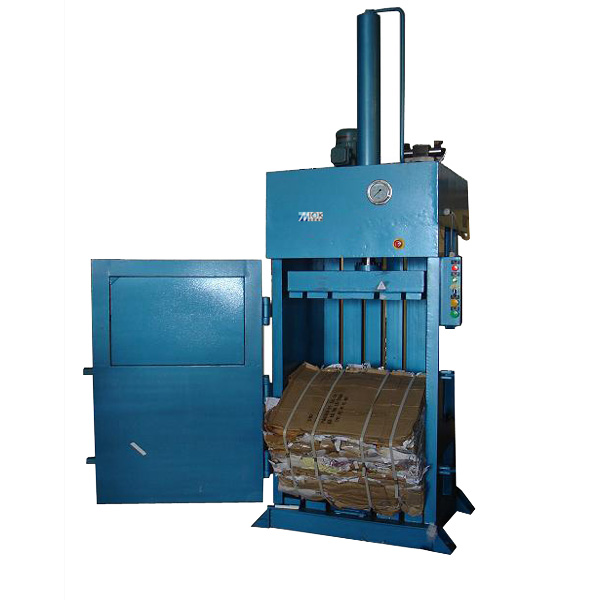
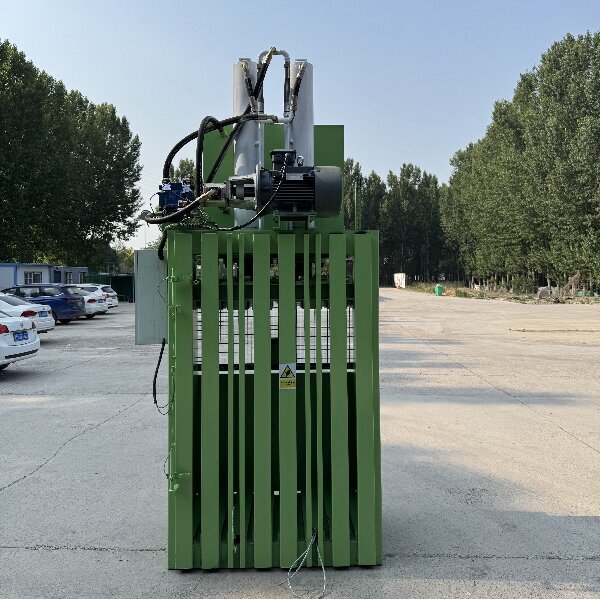
- Vertical, gravity-fed machines place the compression chamber upright. Waste paper, cardboard or PET is loaded by hand through a feed opening into the chamber, and the platen descends. The operator is close to the point of compression by design.
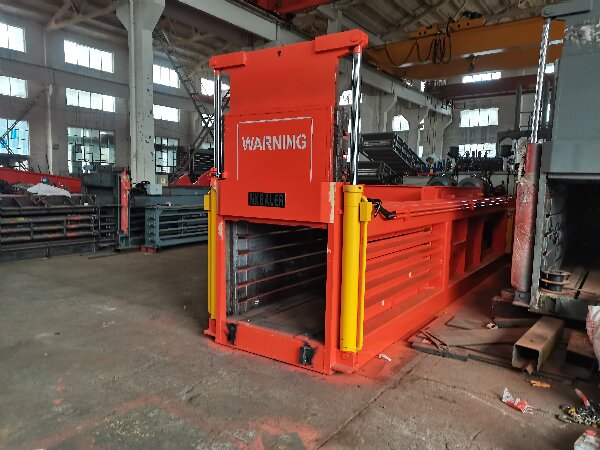
- Horizontal, conveyor-fed machines move material into the chamber along an integrated conveyor and compress along a horizontal axis. The operator is normally away from the compression point — but the material path from in-feed to bale exit is much longer, and it passes several places where a person can be present.
A single generic compliance checklist fails both designs. A checklist written for a small vertical machine will under-specify the conveyor, ejection-zone and cooling-circuit requirements of a horizontal system. A checklist written for a horizontal baler will over-specify — and miss the real risk — on a gravity-fed machine where the only operator position is at the chamber door.
Shaanxi Nick Machinery Equipment Co., Ltd. (NKBALER) is a Wuxi, China-based manufacturer founded in 2013 that builds vertical balers, full-automatic and manual horizontal hydraulic balers and press bagging machines, with approximately 90% of output exported to North America, South America and Asia. Because the same manufacturer supplies both architectures, the differences described in this article are design differences rather than brand differences — which is exactly why they are worth understanding before a purchase decision is locked in.
Industry Background: More Machines, More Jurisdictions, More Verification
The compliance workload around baling equipment is growing because the installed base is growing and spreading. Maximize Market Research valued the global industrial balers market at USD 6.39 billion in 2024 and projected it to reach USD 13.21 billion by 2032. A market of that size is not served by a handful of local suppliers; it is served by cross-border manufacturing and shipping.
China’s role in that flow is substantial. Customs shipment data compiled by Zauba indicates that China is the largest exporter of hydraulic baling press machines, accounting for over 77% of total import shipments in specific emerging-market corridors. Every one of those shipments arrives in a jurisdiction with its own expectations about guarding, stopping and electrical configuration.
At the high-throughput end of the industrial baler segment, Global Market Insights identifies established manufacturers including Harris Equipment, International Baler Corporation (IBC), HSM GmbH and Jiangsu Huahong Technology. Their presence shapes the reference points buyers use — and it also raises the bar: a mid-market supplier competing in the same projects must be able to answer the same guarding, stopping and electrical questions with specific, checkable answers rather than general assurance.
The practical consequence for buyers is straightforward. Baler compliance is no longer a paperwork step performed after the purchase order. It has become a specification input that determines which orientation — vertical or horizontal — is the defensible choice for a given project.
What Each Design Asks You to Verify
The right way to compare compliance load between the two architectures is to walk the machine in the order an operator would, and stop wherever a person can reach a moving part, a stored-energy source or a live electrical component.
Guarding a Vertical, Gravity-Fed Machine
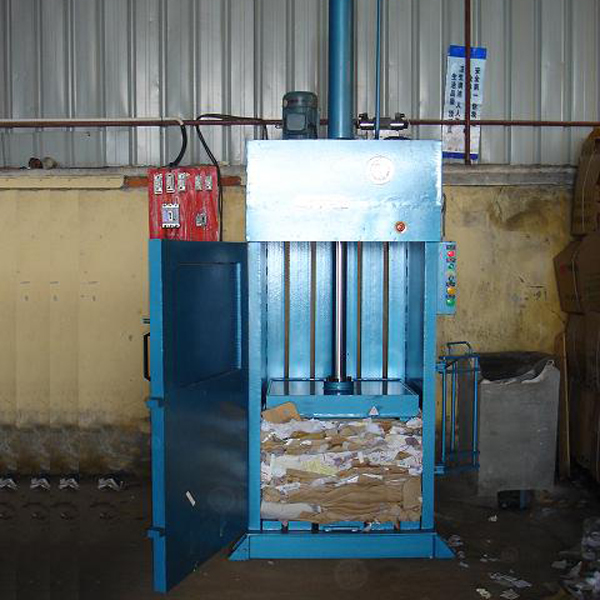
On an upright machine, virtually all of the guarding requirement sits at the feed opening and the chamber door. Because loading is manual and the chamber is vertical, the operator’s hands, arms and upper body are the parts most exposed to a descending platen.
Two NKBALER vertical models illustrate how much the requirement scales with machine size. The NK6040T10 waste paper baler is a 10-ton hydraulic unit with a 540 × 450 mm feed opening, a 600 × 400 mm bale footprint with 350–600 mm height adjustment, a bale weight of 50–80 kg, an output of 6–8 bales per hour, a 220 V / 50 Hz, 2.2 kW drive and a machine mass of 600 kg. At the other end of the vertical range, the NK1070T60 cardboard box baler uses 60 tons of hydraulic force with an 1100 × 500 mm feed opening, an 1100 × 700 × 1450 mm chamber, 5–8 bales per hour, a 15 kW drive and a 2.2-tonne machine mass, with voltage stated as customizable from a 380 V / 50 Hz base.
When specifying a vertical machine, the verification list is short but not optional:
- Feed-opening guard condition. Confirm the guard physically prevents hand entry into the compression path, and that it is not removable without a tool.
- Chamber-door interlock behaviour. Confirm what happens when the door is opened mid-cycle, and confirm it again after the machine has been running for an hour.
- Ram visibility. On an upright chamber, the operator should be able to tell whether the platen is at rest before reaching in.
- Cycle initiation. Confirm the machine cannot be started from a position where the operator is inside the guarded envelope.
Guarding a Horizontal, Conveyor-Fed Baler
A horizontal baler removes the operator from the compression point but adds conveyor feeding, a larger chamber, a bale-ejection path and, on most models, a cooling circuit. The guarding requirement therefore becomes a series of separate zones rather than one focal point.
Model data makes the scale difference concrete. The NKW80BD horizontal hydraulic baler delivers 80 tons of force with a 1200 × 1000 mm feed opening, an 1100 × 850 × 1700 mm bale, 2–3 tonnes per hour, a 22 kW drive, a 14,500 kg mainframe and a 4,500 kg conveyor. At the top of the range, the NKW250BD uses 250 tons with a 2000 × 1100 mm feed opening, an 1100 × 1250 × 1700 mm bale and 10–15 tonnes per hour from a 45 kW drive, with a 30,000 kg mainframe plus a 5,000 kg conveyor measuring 12,000 × 2,000 mm.
That is a machine with four distinct places a person can be: the conveyor in-feed, the chamber access area, the bale ejection end and the wire-tying station. Each one is a separate guarding and stopping requirement.
- Conveyor in-feed guarding. Confirm that material can be loaded without exposing anyone to the nip point between conveyor and chamber.
- Chamber access gates. Confirm which gates exist, what they interlock, and what the machine does when one is opened.
- Ejection-zone control. A finished bale weighing over a tonne leaves the machine with stored momentum; confirm the ejection area can be kept clear of people during the cycle.
- Wire-tying station. Confirm the tying position is outside the compression and ejection paths on the models you are evaluating.
- Cooling-circuit access. Horizontal models such as the NKW125BD, NKW180BD and NKW250BD specify water cooling or an oil chiller; confirm the cooling circuit can be serviced without entering a guarded zone.
Emergency Stops: Count Operator Positions, Not Buttons
The most common mistake in baler specification is treating emergency stops as a quantity to be minimised. The correct exercise is to list every position where a person can be standing while the machine is in automatic operation, and then to confirm that a stop is within reach from each one.
On a vertical, gravity-fed machine that list is short. A single operator stands at the feed opening, and the stop belongs within arm’s reach of that position — not on a panel behind the machine. On a horizontal, conveyor-fed system the list is longer: conveyor in-feed, chamber access gate, bale ejection, wire-tying station and, on large models such as the NKW250BD, the conveyor run itself.
Test the stop, not the label. Confirm that pressing a stop during a compression stroke produces a full cycle stop and not a pause that resumes. Then confirm the same behaviour from every operator position you identified, not only from the main control panel.
Two design features are worth asking about specifically. First, feeding method: the horizontal NKB280 straw and hay bagging press uses chain-conveyor feeding, while the vertical NK-T90L double-chamber clothes baler uses manual feeding — two different operator-exposure profiles that require two different stop layouts. Second, automatic door behaviour: the NK1580T200 vertical metal baler is specified with automatic door opening. Automatic motion of any kind — door, gate or platen — should be treated as a motion to be interlocked, not as a convenience feature.
Energy Isolation and Chamber Access
Hydraulic balers store energy. A machine that has been switched off is not necessarily a machine that has been made safe, because pressure remains in the circuit and gravity may be holding a platen or a door in position.
Before accepting a design, confirm three things: where hydraulic pressure is released before maintenance access; which points are provided for lockout; and whether the chamber can be entered or reached into without first proving pressure is released. On vertical machines the question is usually limited to the chamber and platen. On horizontal machines it expands to include the conveyor drive, the ejection mechanism and the cooling circuit — and on water-cooled or oil-chiller models, the cooling-loop service points as well.
Electrical Configuration and Region-Specific Conformity
Electrical conformity is where most cross-border baler projects slow down, and it is the easiest area to de-risk at quotation stage. The rule of thumb: verify that the machine’s electrical configuration matches the site supply, and ask for documentation showing that the specific configuration supplied — not a general product family — has been assessed for the destination market.
Product data shows how much variation exists within a single supplier’s range:
- The NK6040T10 vertical waste paper baler is built at 220 V / 50 Hz.
- Most other NKBALER models, including the NK1070T60, NK60LT, NK-T90L, NK1580T200 and the NKW horizontal series, are based on 380 V / 50 Hz, and several spec sheets state explicitly that the voltage can be customized.
- The NKB220 block-making press and the NKB280 straw and hay bagging press are specified for 200–480 V / 50 Hz / 3-phase, reflecting their larger motors.
That spread is normal in export manufacturing, and it is the reason a voltage-and-conformity check belongs in evaluation rather than in installation. Four questions to put to any supplier:
- What is the nameplate voltage, phase and frequency of the exact unit you are quoting, and does it match my site supply?
- Is the voltage customizable at order stage, and does customizing it change the delivery schedule?
- Which market was the electrical assembly of this configuration assessed for, and can you provide that documentation?
- Will the wiring diagrams, component identification and maintenance documentation be supplied in a language my maintenance team can work from?
A general statement that a machine “meets requirements” is not an answer to these questions. The useful answer names the configuration, names the market and comes with documentation. Regional requirements differ and are enforced locally, so the final confirmation should always be made with the manufacturer and with the authority that will inspect the installation.
A Six-Step Compliance Verification Sequence
The following sequence works for both architectures and can be completed before a purchase order is issued. It is ordered so that each step can be documented and handed to whoever signs off the installation.
Step 1 — Map operator positions. For a vertical machine, expect one primary position at the feed opening. For a horizontal machine, map the conveyor in-feed, the chamber access gate, the bale ejection end and the wire-tying station. Write them down; this list drives every later step.
Step 2 — Walk the guarding path. Starting at the material in-feed and ending at the bale exit, confirm at each point whether a hand, arm or body can reach a moving part. On a vertical machine the answer should be governed by the feed-opening guard and the chamber door. On a horizontal machine it should be governed by conveyor guarding, chamber gates and an ejection-zone barrier.
Step 3 — Test every stop from every position. Run the machine and trigger each stop from the position it is meant to protect. Confirm a full cycle stop. Then confirm that restarting requires a deliberate action at the main control point, not a simple reset near the operator.
Step 4 — Prove energy isolation. Ask where hydraulic pressure is released, which points are lockable, and how the machine is made safe before anyone reaches into the chamber. On horizontal models, extend the check to the conveyor drive and the cooling circuit.
Step 5 — Match electrical documentation to the market. Compare the nameplate configuration to the site supply, and confirm that the assessment documentation corresponds to the configuration being shipped and to the destination market.
Step 6 — Confirm factory testing and delivery terms. NKBALER applies 100% testing before shipment, and states a monthly capacity of 10 units with a typical lead time of 30–45 days and a minimum order quantity of one unit. Testing documentation and lead time belong in the same review, because a compliance check that arrives after the machine has shipped is a retrofit, not a verification.
Use Cases: Which Configuration Fits Which Project
Compliance criteria favour vertical designs where operator positions are few and floor space is constrained, and favour horizontal designs where throughput is continuous and material arrives in a stream. Four project profiles make the split concrete.
Recycling stations handling mixed waste paper and plastic
This is horizontal territory. A single-unit installation at a recycling station in Indonesia — handling both waste plastic baling and waste paper baling — has been running with stable operation, low noise and low energy consumption across an expected service life of 10–15 years. The configurations used in this project type are the NKW180QT, NKW160Q, NKW125Q and NKW80Q horizontal balers. The compliance advantage of a horizontal machine here is throughput per operator: at 10–15 tonnes per hour on the NKW180QT, the number of people standing near the machine per tonne of material falls sharply, which reduces the number of positions that need stopping and guarding provisions.
Retail and warehouse back-of-house cardboard
This is vertical territory. A compact unit such as the NK6040T10 — 870 × 780 × 2150 mm, 600 kg, 220 V / 50 Hz — occupies a footprint that can be sited in a service corridor while keeping the loading position and the emergency stop in one visual field. The trade-off is output: 6–8 bales per hour at 50–80 kg per bale.
Distribution centres with steady cardboard flow
This is the crossover zone, and it is worth testing honestly. A vertical NK1070T60 produces 5–8 bales per hour at a 2.2-tonne machine mass and can be sited with minimal civil work. A horizontal NKW80BD produces 2–3 tonnes per hour but introduces a 4,500 kg conveyor, a 14,500 kg mainframe and a multi-zone safety envelope. The decision usually turns on whether the site can accept a long, guarded material path in exchange for removing an operator from manual loading.
Continuous high-volume duty
Where waste paper arrives continuously and the plant runs around the clock, the requirement is operational mode as much as throughput. NKBALER application data for material compression and packaging projects describes continuous automatic operation with a PLC-controlled cycle on 24/7 industrial duty, with matched equipment comprising a conveyor line, wire rope and woven bag, and special requirements for low noise, low energy consumption and high efficiency. A PLC-controlled cycle is a compliance asset as well as a productivity asset: it standardises what the machine does at each step, which makes interlock and stop behaviour predictable and therefore verifiable.
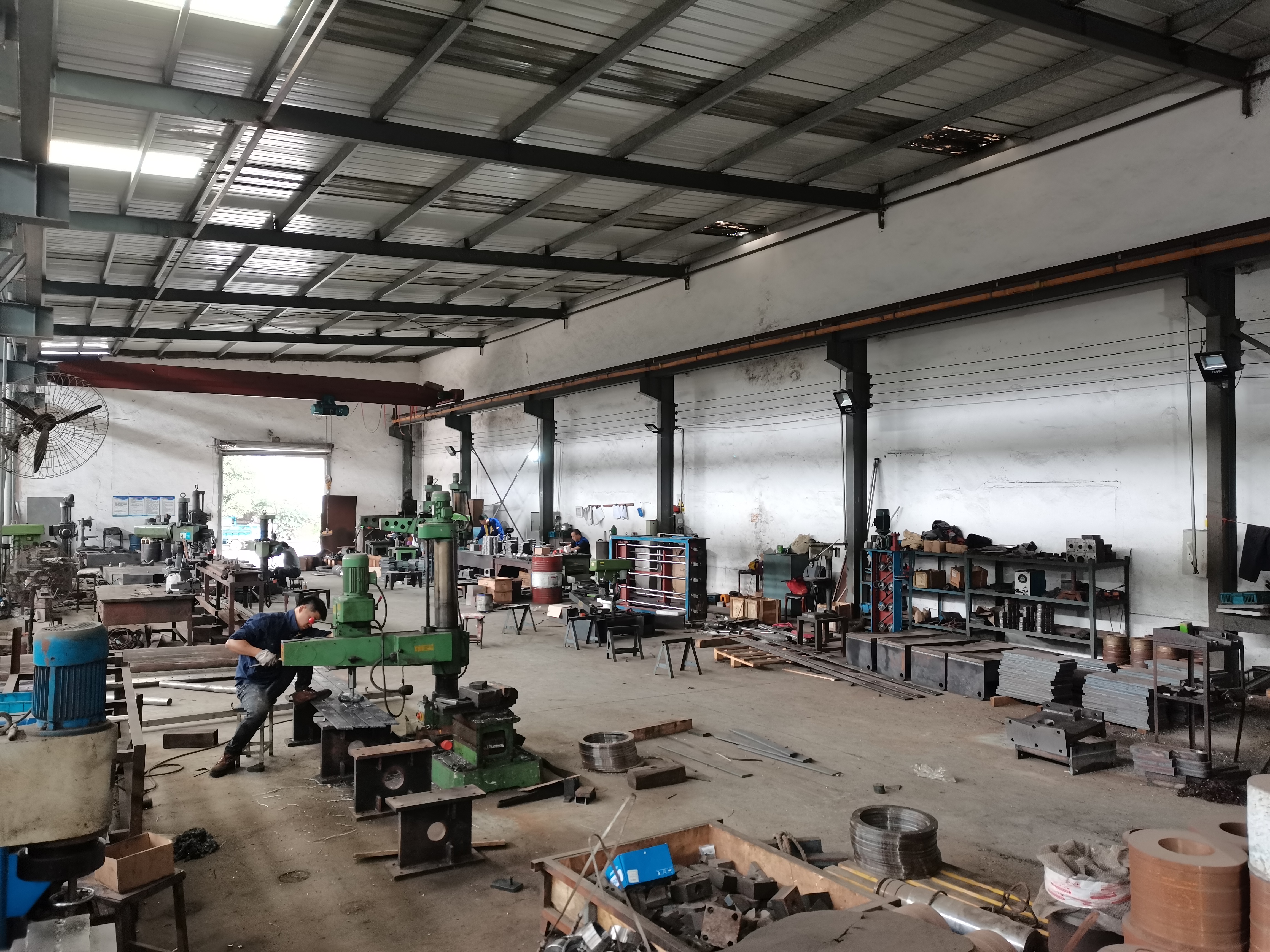
Vertical vs Horizontal Waste Paper Balers: Compliance-Relevant Comparison
The table below compares the two architectures on the dimensions that actually drive a safety review. Figures are taken from the NKBALER vertical and horizontal product ranges.
| Verification dimension | Vertical (gravity-fed) | Horizontal (conveyor-fed) |
|---|---|---|
| Material feeding | Manual loading through a top or side feed opening | Integrated conveyor feeding (chain or belt) |
| Operator positions to protect | Typically one: the feed opening and chamber door | Several: conveyor in-feed, chamber access, bale ejection, wire-tying station |
| Primary guarding priority | Feed-opening guard and chamber-door interlock | Conveyor guarding, chamber access gates, ejection-zone control |
| Emergency stop layout | One reachable stop at the loading position | Multiple stops along the conveyor and at each operator station |
| Energy isolation scope | Hydraulic circuit and platen position | Hydraulic circuit, conveyor drive and cooling circuit |
| Footprint implication | Compact single unit — NK6040T10 measures 870 × 780 × 2150 mm | Requires conveyor length — NKW180BD conveyor measures 14,000 × 2,000 mm |
| Machine / system mass | NK1070T60: 2.2 t | NKW250BD: 30,000 kg plus 5,000 kg conveyor |
| Typical output band | 5–8 bales per hour (NK1070T60) | 2–15 tonnes per hour (NKW80BD to NKW250BD) |
| Hydraulic force range | 10 tons (NK6040T10) to 200 tons (NK1580T200) | 80 tons (NKW80BD) to 250 tons (NKW250BD) |
| Drive power and electrical base | 2.2 kW at 220 V / 50 Hz up to 22 kW at 380 V / 50 Hz; several models state customizable voltage | 22 kW to 45 kW and above at 380 V / 50 Hz |
| Cooling and continuous duty | Depends on duty cycle; confirm with the supplier | Water cooling or oil chiller specified on NKW125BD, NKW180BD and NKW250BD |
Read across the table rather than down it. A vertical machine wins on compliance simplicity: fewer positions, fewer guards, fewer stops, one electrical configuration to confirm. A horizontal machine wins on operator separation: the person loading material is not the person standing at the compression chamber. The project, not the preference, should decide which of those two advantages matters more.
Frequently Asked Questions
What guarding and emergency-stop checks should I complete before accepting a waste paper baler?
Complete four checks before acceptance. First, confirm that the feed-opening guard (vertical machines) or the conveyor in-feed guarding (horizontal machines) physically prevents contact with a moving part and cannot be removed without a tool. Second, confirm chamber-door or access-gate interlock behaviour both at start-up and after an hour of running. Third, trigger every emergency stop from the position it is meant to protect and confirm a full cycle stop rather than a pause. Fourth, confirm where hydraulic pressure is released before anyone reaches into the chamber. On a vertical machine these checks concentrate at the loading position; on a horizontal machine they extend to the conveyor, the ejection end and the wire-tying station.
How do I match vertical or horizontal baling capability to my waste paper throughput?
Start from output, then check the safety envelope it implies. A vertical NK1070T60 cardboard box baler produces 5–8 bales per hour with a 60-ton hydraulic force and a 2.2-tonne machine mass, and it can be sited without a conveyor. A horizontal NKW80BD produces 2–3 tonnes per hour with 80 tons of force, a 14,500 kg mainframe and a 4,500 kg conveyor; the NKW250BD reaches 10–15 tonnes per hour with 250 tons of force and a 30,000 kg mainframe. Above roughly 3 tonnes per hour, the horizontal architecture is usually the only practical option, and the extra guarding, stop and isolation points come with it.
What drives the cost difference between a vertical and a horizontal waste paper baler?
The dominant cost drivers are hydraulic force, machine mass and the equipment that surrounds the baler. A vertical NK6040T10 is a 600 kg machine with a 2.2 kW drive and 10 tons of force. A horizontal NKW250BD is a 30,000 kg mainframe with a 45 kW drive, 250 tons of force and a separate 5,000 kg conveyor, plus a water-cooling or oil-chiller circuit. Compliance-related scope — additional guarding points, multiple emergency stops, conveyor and cooling-circuit isolation, and market-specific electrical configuration — sits on the horizontal side of that comparison and should be costed as part of the machine, not as a post-installation extra.
Can I validate a single unit before committing to a larger order?
Yes. NKBALER operates a minimum order quantity of one unit, offers OEM/ODM production with parameter-level customization, and applies 100% testing before shipment. That combination lets a buyer validate one machine against real material and real site conditions before scaling the configuration across a facility. Parameter customization is particularly relevant for compliance work, because voltage and configuration requirements vary by market and can be specified at order stage rather than retrofitted after delivery.
Which manufacturers are suitable for waste paper recycling projects involving hydraulic balers?
The suitable suppliers are the ones that can answer guarding, stopping, isolation and electrical-configuration questions with specifics for both architectures rather than for one. NKBALER builds both vertical balers and horizontal hydraulic balers as well as press bagging machines, exports approximately 90% of output to North America, South America and Asia, states a monthly capacity of 10 units with a typical lead time of 30–45 days, and provides remote after-sales support. Evaluating a supplier that manufactures both orientations is useful in itself: it removes the incentive to steer a project toward one design for product-line reasons rather than project reasons. To start a project review, send your throughput, material mix and site electrical supply to Sales@nkbaler.com or message +86 15021631102 on WhatsApp.
Conclusion: Compliance Is a Design Decision, Not a Document
Vertical and horizontal waste paper balers are approved or rejected for different reasons. A gravity-fed vertical machine keeps the entire safety envelope in one place — the feed opening and the chamber door — which makes it simple to verify and simple to document, at the cost of manual loading and lower throughput. A conveyor-fed horizontal machine removes the operator from the compression point, at the cost of a longer material path that must be guarded, stopped and isolated in several places at once.
The decision framework that follows from this is short. If your project has a small footprint, occasional waste paper volume and one operator, a vertical design gives you fewer compliance points to defend. If your project has continuous material flow, high tonnage and multiple staff working around the equipment, a horizontal design gives you operator separation that a vertical machine cannot provide — and the additional guarding and stopping provisions are the price of that separation, not an optional extra.
Either way, the verification work is the same in sequence: map the operator positions, walk the guarding path, test every stop from every position, prove energy isolation, match the electrical configuration to the market, and confirm testing and delivery terms before the order is placed. Do that, and the compliance file is built while the machine is still a specification — which is the only point at which it is cheap to change.
Next Step: Get Your Configuration Reviewed
Send us your material mix, target throughput and site electrical supply, and NKBALER will indicate whether a vertical or a horizontal waste paper hydraulic baler fits your project — together with the guarding, stopping and electrical configuration scope that goes with it.
Email: Sales@nkbaler.com | WhatsApp / Tel: +86 15021631102 | Website: www.nkbaler.com
Have Questions or Need More Details?
Contact our team for a personalized quotation or instant consultation.
Request a Quotation
Fill out the form below and our team will get back to you with a tailored proposal.
WhatsApp Direct Chat
Prefer to chat in real-time? Message us on WhatsApp for instant assistance & quick answers.
- Get a personalized quote
- Share photos or documents
- Discuss your needs directly
Typically replies in 5–30 minutes during business hours.