
What to Do When Your Hydraulic Baler Output Falls Short: Solving the Throughput Puzzle
What to Do When Your Hydraulic Baler Output Falls Short: Solving the Throughput Puzzle
A waste paper hydraulic baler machine seldom fails outright. It underperforms. A press that produced dense, full-size bales during commissioning gradually delivers fewer bales per shift, bales that are lighter than the target, and more unscheduled stops. By the time the shortfall shows up in labour hours and transport costs, the machine has usually been blamed for a problem that belongs to the wider baling system.
This guide is written for operations managers and recycling facility owners at the Research and Evaluation stage — the point where an existing baler is under-delivering, or where a new line is being specified and the same outcome needs to be avoided. It moves through four stages: defining what “output falls short” actually measures, reviewing the market and compliance background that shapes equipment selection, examining the four throughput levers, and running a seven-step audit that ends with a machine-class decision among vertical units, horizontal hydraulic balers, and press bagging machines.
Problem Definition: What “Output Falls Short” Actually Means
Output shortfall is not one failure mode. In baling operations it usually appears as one of four measurable symptoms, and each symptom points to a different lever:
- Fewer bales per hour than the nameplate rating. The machine completes its cycles, but the count does not add up over a shift. This is normally a feed or cycle-timing issue.
- Bales lighter than the target weight. The press is working, but the material density inside the chamber is lower than the material can achieve. This is usually a pressure, chamber-fill or material-preparation issue.
- More unplanned stops. Jams, wire breaks and manual clearing all consume cycle time. This is often a downstream or bale-handling issue.
- Higher cost per bale. Power, wire, labour and haulage per tonne rise even when the bale count looks acceptable.
The distinction matters because rated capacity is only meaningful under defined conditions. A specification sheet states what a machine can do with a specified material at a specified feed rate. Delivered capacity is what the site actually achieves with its own material mix, staffing pattern, floor layout and shift length. The gap between the two is the throughput puzzle.
Diagnostic rule: before changing any equipment, measure the gap. If delivered output is within roughly the same band as the rated figure, the problem is availability and stoppages. If delivered output sits below the rated band while cycle counts look normal, the problem is feed or material density. If the rated band itself sits below what the site needs, the problem is machine class, not machine condition.
Industry Background: Why Throughput Expectations Keep Rising
Baling is no longer a housekeeping activity at the back of a facility. It is a throughput stage with its own economics. The global industrial balers market was valued at USD 6.39 billion in 2024 and is projected to reach USD 13.21 billion by 2032, according to Maximize Market Research. A market of that trajectory reflects more material entering recovery streams, tighter bale specifications from mills, and rising haulage costs that punish low-density bales.
The supply side of that market is concentrated. China is the largest exporter of hydraulic baling press machines, accounting for over 77% of total import shipments in specific emerging market corridors, based on Zauba customs data. For buyers, that means a wide field of suppliers quoting similar-looking machines with very different build and support levels.
Two classification and compliance facts are worth holding onto during evaluation. Hydraulic baling press machines for waste paper are commonly classified under HS Code 842240 (packing or wrapping machinery) or 846291 (hydraulic presses for working metal or scrap), which affects duties and documentation. Horizontal baling presses placed on the EU or UK market must comply with EN 16252:2012 (BS EN 16252:2012 in the UK) for CE marking, per BSI Knowledge.
The competitive field is also documented. Analysis published by Global Market Insights lists Harris Equipment, International Baler Corporation (IBC), HSM GmbH and Jiangsu Huahong Technology among the major global competitors in the high-throughput industrial baler market. NKBALER — the trading name of Shaanxi Nick Machinery Equipment Co., Ltd., founded in 2013 — is a Chinese manufacturer that builds vertical balers, manual and full-automatic horizontal balers, and press bagging machines from a 5,000 m² facility with a 15-person R&D team and an annual output of 600 units listed in its company profile. Around 90% of that output is exported, primarily to North America, South America and Asia.
That structure explains a common evaluation error. Buyers compare presses on force and price, then discover that the throughput ceiling came from a feed opening that was too small, a conveyor that was too narrow, or a bale format the haulier will not accept. The press was never the bottleneck.
Detailed Solution: The Four Throughput Levers
Lever 1 — Feed system match
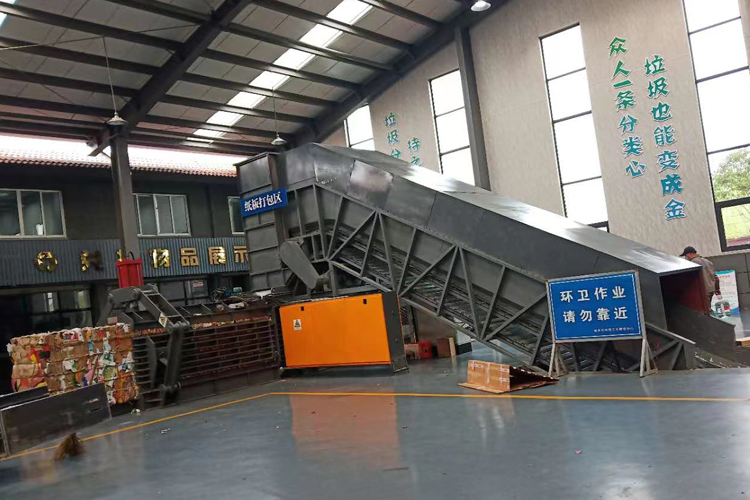
The feed side sets the practical ceiling on any baling machine. Three dimensions decide it: feed opening size, chamber size, and the type and width of the conveyor that delivers material.
Opening and chamber geometry are stated plainly on NKBALER specification sheets. A vertical cardboard baler such as the NK1070T60 has a 1,100 × 500 mm feed opening and a 1,100 × 700 × 1,450 mm chamber. A horizontal unit such as the NKW125BD has a 2,000 × 1,100 mm feed opening, and the NKW180BD opens to 2,400 × 1,100 mm. When a site loads a large chamber by hand, the operator — not the hydraulic system — controls the cycle count.
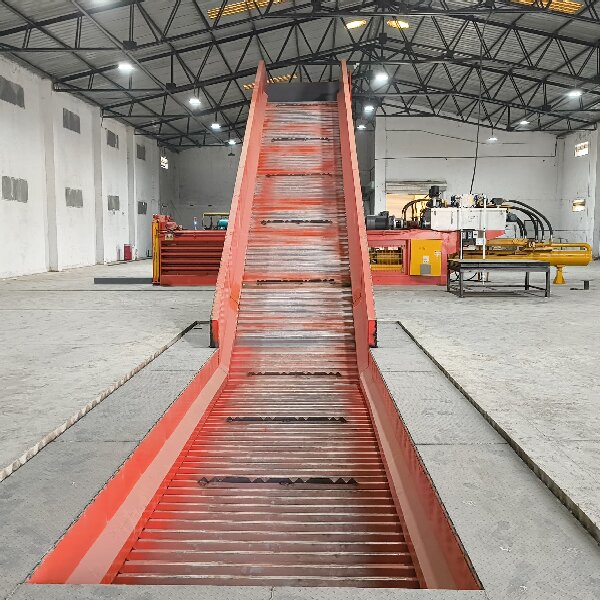
Conveyor specification is the second half of the feed equation, and it is frequently under-sized. The NKW125BD is specified with a 12,000 × 1,800 mm conveyor driven by a 4.5 kW motor; the NKW180BD uses a 14,000 × 2,000 mm chain steel conveyor with a 5.5 kW motor; the NKW80Q pairs a 1,200 × 12,000 mm conveyor with a 4 kW motor. A narrow or short conveyor that cannot buffer surges will starve the press even when the press itself is capable of more.
Lever 2 — Cycle timing, pressure and cooling
Cycle timing converts hydraulic capability into bales per hour. Two parameters dominate: system pressure and the time taken for one complete compress-and-eject sequence.
NKBALER horizontal models span a working pressure range from 18 MPa on the NKW80BD, through 20 MPa on the NKW125BD, 21 MPa on the NKW180BD, NKW80Q and NKW125Q, 23 MPa on the NKW250BD, 25 MPa on the NKW160Q, and 30.5 MPa on the NKW180QT. Pressure influences achievable bale density, which in turn influences bale weight and haulage economics. On vertical cutting and baling units, single-cycle time is stated directly — the NKC150 lists a single time of 40–50 seconds at 15 MPa and 22 kW.
Thermal behaviour is an underrated throughput variable on continuous duty. Horizontal NKBALER models are specified with either a water-cooling circuit or an oil chiller; the NKW80BD and NKW125BD list a cooling fan within the same specification block. A machine that has to be slowed or stopped to manage heat will not reach its rated hourly figure across a full shift. Application data for continuous baling operations describes the expected duty as PLC-controlled cycles running on a 24/7 industrial pattern, which makes cooling a production parameter rather than an accessory.
Lever 3 — Machine class selection
The most expensive throughput error is buying in the wrong class. The three NKBALER product families solve different problems.
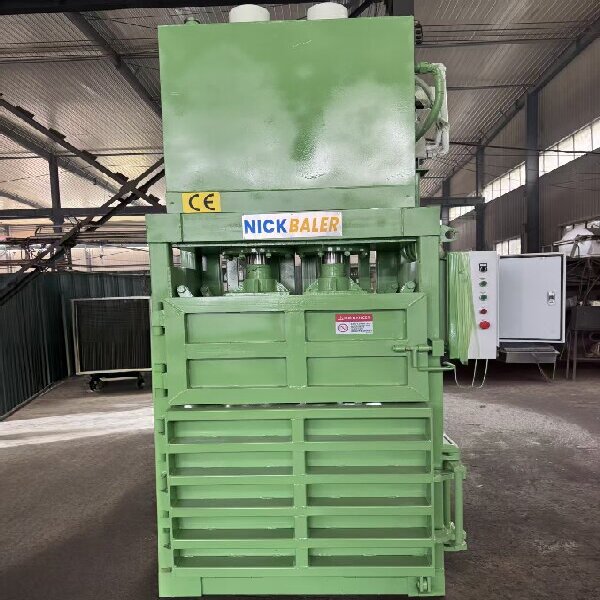
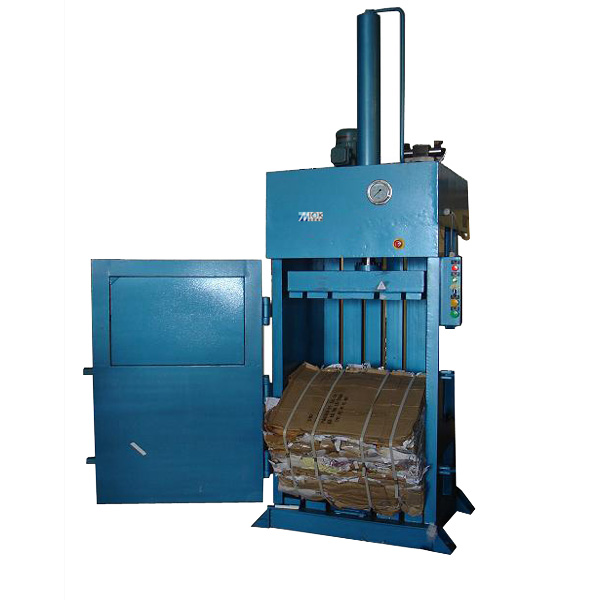
Vertical balers compress downwards in a fixed chamber and are typically loaded manually. They suit low to moderate volumes and constrained floor space. Rated capability is expressed in bales per hour: the NK6040T10 at 6–8 bales/hour, the NK1070T60 at 5–8 bales/hour, the NK080T100 at 3–6 bales/hour, the NK1580T200 at 3–6 bales/hour, and the NK110T150 at 4–6 bales/hour for fibre-type material.
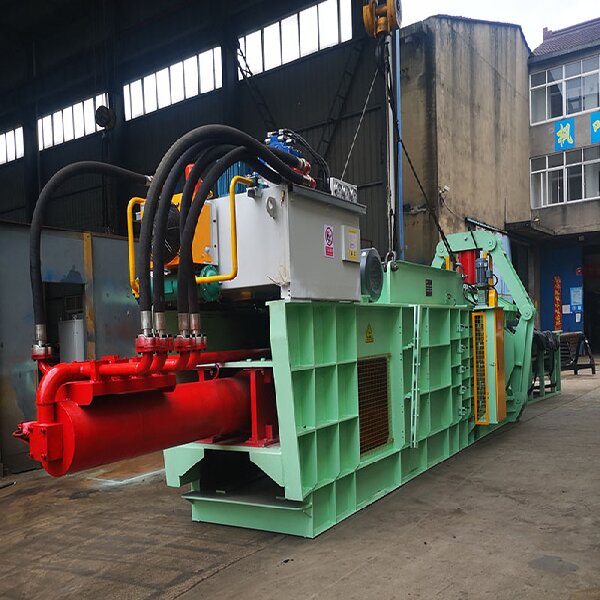
Horizontal hydraulic balers compress along the horizontal axis and are fed by conveyor, which is what allows continuous throughput. Rated capability is expressed in tonnes per hour: the NKW80BD at 2–3 T/hour, the NKW125BD at 5–7 T/hour, the NKW180BD at 6–8 T/hour, and the NKW250BD at 10–15 T/hour. The Q series follows a similar ladder, with the NKW80Q at 3–5 T/hour, the NKW125Q at 10–12 T/hour, and both the NKW160Q and NKW180QT at 12–15 T/hour.
Press bagging machines handle materials that need a controlled bag or block format rather than a conventional mill bale. The NKB280 straw and hay bagging machine is rated at 30–32 bales/hour and 10–12 T/hour with a 1,100 × 1,200 × 800 mm bale, while the NKB220 block making machine is rated at 90 blocks/hour and 2.5–3 T/hour with a 22-second compress time. The NKB10 and NKB20 constant weight bagging machines produce 1–1.5 kg and 20 kg units respectively, which is a different throughput model again.
Lever 4 — Downstream handling and bale format
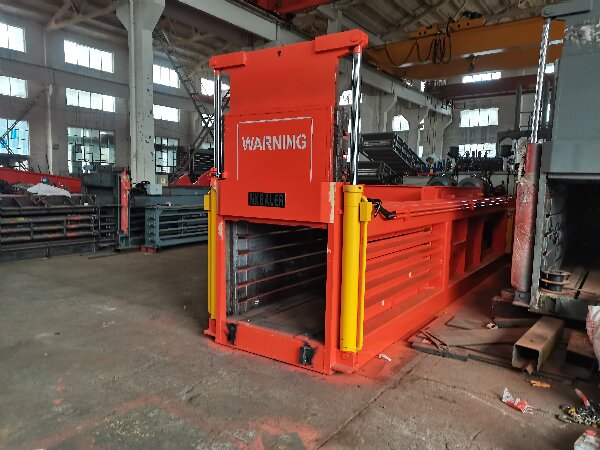
Throughput ends where handling begins. Bale wire specification, bale weight, and bale dimensions all determine how fast a finished bale leaves the press area. NKBALER horizontal models list wire requirements of 6#/8# × 5 pieces on the NKW180BD and NKW250BD, 10# × 5 pieces on the NKW125BD, and 10# × 4 pieces on the NKW80BD. Under-specified wire produces broken bales; over-specified wire slows the tying step.
Bale weight ranges matter commercially as well. Vertical fibre and metal units produce bales from 200 kg up to 1,000–2,000 kg depending on model, while horizontal waste paper units work in the 1,100 × 1,250 × 1,700 mm format class. If the receiving mill or haulier rejects that format, the site will re-handle bales regardless of press capability.
Step-by-Step Breakdown: A Seven-Step Throughput Audit
The audit below is designed to be run in a single shift with existing staff. It produces a defensible answer to the question of whether the site has a maintenance problem, a feed problem, or a machine-class problem.
- Establish a real baseline. Count finished, strapped, saleable bales across a full shift — not a peak hour. Record the material type, the number of operators on the feed side, and any stoppage events with their duration.
- Compare the baseline with the rated figure. Convert both to the same unit. Vertical NKBALER models are rated in bales per hour; horizontal models in tonnes per hour. Comparing a bales-per-hour figure against a tonnes-per-hour specification is one of the most common evaluation mistakes.
- Time one complete cycle. From the start of compression to bale ejection, on a chamber filled to normal level. If cycle time is materially longer than the machine should need, service the hydraulics and cooling circuit before changing equipment.
- Audit the feed. Measure the feed opening against the largest piece of material entering it. Check whether the conveyor width and length buffer surge loads. Confirm whether operators are preparing material — flattening cardboard, opening containers — that the specification assumed would arrive ready.
- Inspect bale quality against density targets. NKBALER specification sheets list material density bands for several horizontal models: 300–400 kg/m³ for the NKW80Q, 400–600 kg/m³ for the NKW160Q, and 500–600 kg/m³ for the NKW125Q and NKW180QT. Bales consistently below the intended band indicate a fill, pressure or material-moisture issue rather than a capacity limit.
- Check utilities and environment. Confirm the supply matches the machine requirement — horizontal NKBALER models are listed at 380V/50Hz, and the NKB280, NKB220 bagging units accept 200–480V/50Hz/3-phase. Voltage is noted as customizable on models including the NK60LT and the NK1070T60. Also verify that ambient temperature and dust are within the conditions the cooling system was sized for.
- Re-select the class if steps 1–6 confirm a structural gap. If the site’s material volume has grown beyond the rated band of the installed machine, no adjustment will close the gap. This is the point at which a vertical-to-horizontal move, or a step up the horizontal ladder, becomes the correct decision.
Use Cases: Matching Material Volume and Floor Space to the Right Machine
Case A — Back-dock cardboard at a distribution or retail site
Material arrives in bursts when trailers are unloaded, and floor space is tight. A vertical cardboard box baler machine such as the NK1070T60 fits the pattern: 60-ton hydraulic power, a 1,100 × 500 mm feed opening, a 1,100 × 700 × 1,450 mm chamber, 15 kW power draw and a rated 5–8 bales per hour, in a machine footprint of 1,600 × 1,100 × 3,200 mm. The correct action when output falls short here is usually to fix feed discipline and staffing, not to replace the press.
Case B — Waste paper at a mid-volume transfer station
Once a site handles paper and cardboard continuously rather than in bursts, the horizontal class becomes the appropriate choice. The NKW125BD is specified at 125-ton hydraulic force, a 2,000 × 1,100 mm feed opening, a 1,100 × 1,250 × 1,700 mm bale, 30 kW main power, a 12,000 × 1,800 mm conveyor at 4.5 kW, material density of 500–600 kg/m³ and a rated 5–7 T/hour. This is the band where a vertical unit frequently becomes the throughput bottleneck rather than the solution.
Case C — High-volume paper recycling or MRF line
Where throughput is the primary economic driver, the ladder continues through the NKW180BD at 180-ton force and 6–8 T/hour, and the NKW250BD at 250-ton force, a 1,100 × 1,250 × 1,700 mm bale and 10–15 T/hour with a 12,000 × 2,000 mm conveyor. The Q series offers comparable bands with different chamber and density characteristics, including the NKW160Q and NKW180QT at 12–15 T/hour. Selection here is driven less by nominal tonnage and more by material density, moisture and the bale format the downstream mill accepts.
Case D — Observed field configuration: recycling station, Indonesia
One documented NKBALER installation involves a recycling station manufacturer in Indonesia running a single horizontal hydraulic baler for both waste plastic baling and waste paper baling. The recorded outcome is stable operation, with low noise and low energy consumption identified as the project highlights. For sites with a mixed material stream, this configuration illustrates a practical point: a horizontal unit sized for the dominant material can cover a secondary stream, provided the density bands of both materials are checked before purchase rather than after.
Comparison Table: The Throughput Ladder for Waste Paper and Cardboard
The table below compares NKBALER vertical and horizontal models that are commonly evaluated for waste paper and cardboard duty. All figures are taken from published model specifications.
| Model | Class | Hydraulic force | Feed opening | Rated capability | Bale size (as specified) | Power |
|---|---|---|---|---|---|---|
| NK6040T10 | Vertical, waste paper | 10 ton | 540 × 450 mm | 6–8 bales/hour | 600 × 400 × (350–600) mm | 2.2 kW |
| NK1070T60 | Vertical, cardboard box | 60 ton | 1,100 × 500 mm | 5–8 bales/hour | 1,100 × 700 × (500–900) mm | 15 kW |
| NKW80BD | Horizontal | 80 ton | 1,200 × 1,000 mm | 2–3 T/hour | 1,100 × 850 × 1,700 mm | 22 kW |
| NKW125BD | Horizontal | 125 ton | 2,000 × 1,100 mm | 5–7 T/hour | 1,100 × 1,250 × 1,700 mm | 30 kW |
| NKW125Q | Horizontal | 125 T cylinder force | 2,000 × 1,100 mm | 10–12 T/hour | 1,100 × 1,100 × ~1,600 mm | 37.5 kW + 11 kW |
| NKW180BD | Horizontal | 180 ton | 2,400 × 1,100 mm | 6–8 T/hour | 1,100 × 1,150 × 1,800 mm | 45 kW |
| NKW180QT | Horizontal | 160 T cylinder force | 2,000 × 1,100 mm | 12–15 T/hour | 1,100 × 1,250 × ~1,600 mm | 45 kW + 7.5 kW |
| NKW250BD | Horizontal | 250 ton | 2,000 × 1,100 mm | 10–15 T/hour | 1,100 × 1,250 × 1,700 mm | 45 kW |
Note on bale dimensions: NKBALER specification sheets list vertical unit bale sizes as L×W×H and horizontal unit bale sizes as W×H×L. Values above are reproduced as published. Models rated in tonnes per hour and models rated in bales per hour are not directly comparable without converting to a common unit using the actual bale weight achieved on site.
Frequently Asked Questions
What compliance requirements apply to a horizontal waste paper baler project?
Horizontal baling presses supplied into the European Union must comply with EN 16252:2012 for CE marking, and the equivalent BS EN 16252:2012 applies in the UK, according to BSI Knowledge. On the trade side, hydraulic baling press machines for waste paper are commonly classified under HS Code 842240 (packing or wrapping machinery) or 846291 (hydraulic presses for working metal or scrap), per Volza and Made-in-China customs data. Buyers should request the applicable declaration and test documentation in writing for the specific model and destination market, and confirm the customs classification used on the commercial invoice before shipment. NKBALER states a 100% test regime before dispatch as part of its quality control process.
Which manufacturers are suitable for waste paper recycling projects involving hydraulic balers?
Suitability should be judged against the project rather than the brand name, using four criteria: whether the supplier’s rated capacity band covers the site’s actual throughput, whether the feed opening and conveyor match how material arrives, whether the bale format and density match what the receiving mill accepts, and whether service and spare parts are reachable in the project’s location. Global Market Insights lists Harris Equipment, International Baler Corporation (IBC), HSM GmbH and Jiangsu Huahong Technology among the major global competitors in the high-throughput industrial baler market. NKBALER, the trading name of Shaanxi Nick Machinery Equipment Co., Ltd., is a Chinese manufacturer founded in 2013 that builds vertical balers, manual and full-automatic horizontal balers and press bagging machines, with a 5,000 m² facility, a 15-person R&D team, an annual output of 600 units listed in its company profile, and roughly 90% of output exported to North America, South America and Asia. A supplier is suitable when its documented capacity band, feed geometry and bale format match the material stream the project actually handles.
Can a vertical baler be made to reach the throughput of a horizontal unit?
No. They are different design classes with different throughput models, and the gap is structural rather than tunable. Vertical models are rated in bales per hour — the NK1070T60 at 5–8 bales/hour and the NK6040T10 at 6–8 bales/hour — and rely on manual or limited feeding into a fixed chamber. Horizontal models are conveyor-fed and rated in tonnes per hour, from 2–3 T/hour on the NKW80BD through 5–7 T/hour on the NKW125BD to 10–15 T/hour on the NKW250BD, with feed openings of 2,000 × 1,100 mm or 2,400 × 1,100 mm. A vertical unit remains the correct choice when volume is moderate and floor space is constrained; it becomes the bottleneck when a site’s continuous volume exceeds its rated band.
What lead time and order quantity should a baling project plan for?
NKBALER’s stated capability profile lists a minimum order quantity of one unit, a monthly production capacity of 10 units, and a lead time of 30–45 days, with OEM/ODM production and parameter-level customization available. Projects should add compliance documentation, inland transport to the site and commissioning time on top of the production lead time, and should confirm the voltage requirement early because supply standards differ by market — horizontal NKBALER models are listed at 380V/50Hz, while the NKB280 and NKB220 bagging machines accept 200–480V/50Hz/3-phase, and voltage is noted as customizable on models such as the NK60LT and NK1070T60.
Can the baler be customized to our material and floor space?
Customization in this category is mainly parameter-level rather than cosmetic: voltage, bale size, feed opening arrangement and conveyor length are the variables that most often need to change between sites. NKBALER lists OEM/ODM production mode with parameter customization, a minimum order of one unit, and remote after-sales support. The practical route for a site running a throughput audit is to record the measurements from steps 1–6 — shift bale count, material type, chamber fill, measured cycle time, achieved bale density and available floor footprint — and send them with the enquiry, so the configuration proposal is built on the site’s real numbers rather than an assumed material stream.
Conclusion: Fix the System Before Replacing the Press
When a waste paper hydraulic baler machine under-delivers, the fastest path to recovery is a measured one. Establish the shift baseline, compare it against the correct unit of rated capacity, time the cycle, audit the feed geometry, verify achieved bale density, and check the utilities and cooling duty. In many facilities, that sequence uncovers a feed discipline or conveyor-sizing problem that can be corrected without capital expenditure.
Where the audit confirms a structural gap, the decision becomes a class decision. Vertical balers such as the NK6040T10 and NK1070T60 remain the right fit for moderate volumes and constrained floor space. Horizontal hydraulic balers from the NKW80BD through the NKW125BD, NKW180BD and NKW250BD, along with the Q series, are the correct answer when continuous, conveyor-fed throughput is required. Press bagging machines including the NKB10, NKB20, NKB220 and NKB280 cover materials that need a controlled bag or block format rather than a mill bale.
Next Step: Turn the Audit into a Configuration Proposal
If the seven-step audit points to a machine-class gap, NKBALER can review your shift data, material type and floor plan and respond with a configuration proposal from the vertical, horizontal and bagging ranges. Send your throughput figures, bale format requirement and site footprint to www.nkbaler.com or reach the team directly at Sales@nkbaler.com / +86 15021631102. If your site is running a mixed material stream, say so — it changes the density assumptions the recommendation is built on.
Have Questions or Need More Details?
Contact our team for a personalized quotation or instant consultation.
Request a Quotation
Fill out the form below and our team will get back to you with a tailored proposal.
WhatsApp Direct Chat
Prefer to chat in real-time? Message us on WhatsApp for instant assistance & quick answers.
- Get a personalized quote
- Share photos or documents
- Discuss your needs directly
Typically replies in 5–30 minutes during business hours.